



Basic Knowledge of Ozone | Mechanism & Evidence of Sterilization | AIC
SPECIALIST COLUMN
Basic Knowledge of Ozone
The Truth About Sterilization and Deodorization, Taught by AIC Co., Ltd., Focusing on Ozone Since 2006
1. What is Ozone (O3)?
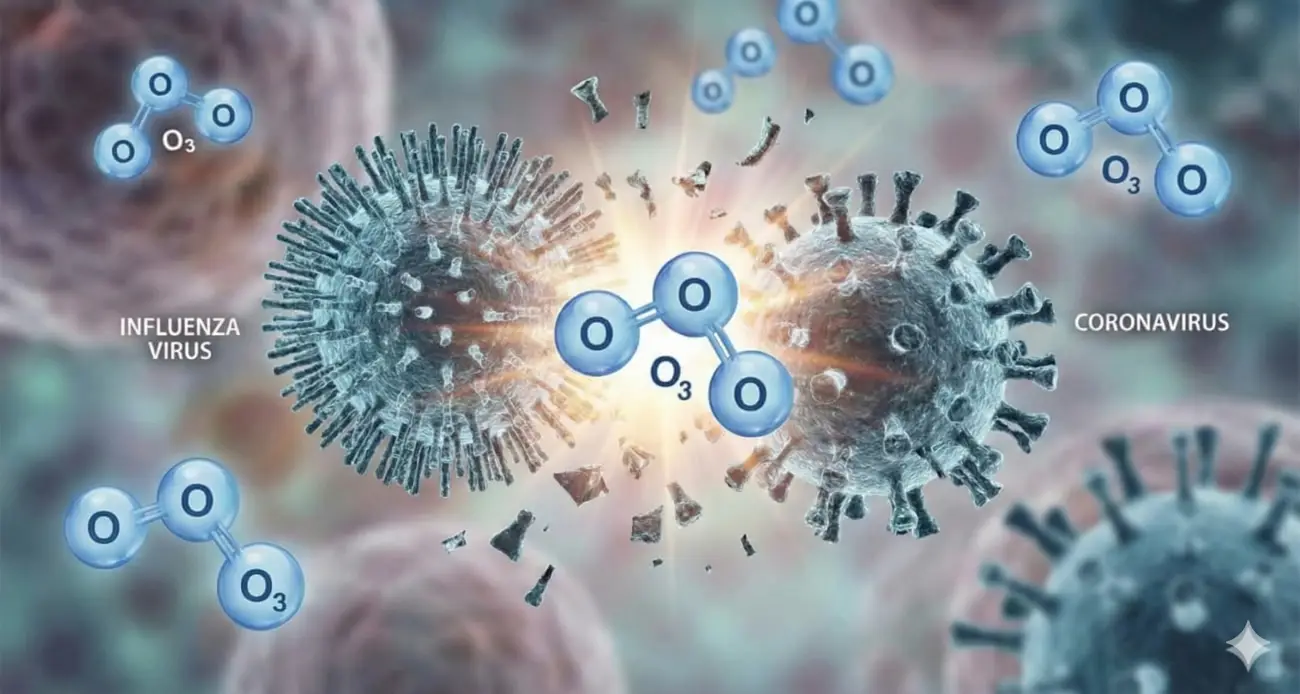
Ozone is a substance consisting of three oxygen atoms and exists in trace amounts in the natural environment (such as forests and coasts).
It possesses strong oxidizing power. When it reacts with bacteria, viruses, and odor molecules, it quickly decomposes and destroys them. Its greatest feature is that it reverts to “oxygen" after the reaction. Because it leaves no harmful residues like chemicals do, it is called the “ultimate clean sterilizer" with extremely low environmental impact.
● A Relative of Oxygen and a Powerful “Allotrope"
From a scientific perspective, ozone (O3) is an “allotrope" of oxygen (O2). Oxygen (O2) consists of two oxygen atoms (O) bonded together, while ozone (O3) consists of three. It refers to a highly energetic and “active state" of oxygen.
This “third atom" is highly unstable. When it finds other substances (bacteria or dirt), it immediately detaches itself to bond (oxidize) with the target. This tremendous energy is the driving force behind its sterilization and deodorization capabilities.
[3 Scientific Characteristics of Ozone]
- ✅ Powerful Oxidizing Power: Possesses high oxidation potential second only to fluorine, physically destroying bacteria and odors from their source.
- ✅ Self-Decomposing: Being a highly unstable substance, it reverts to oxygen (O2) in a short time after reaction.
- ✅ Zero Residue: Unlike chemicals, it is the only sterilizer that requires no post-treatment (like wiping).
The Natural Circulation Cycle of Ozone
“Born from air, returns to air."
The natural self-purification process protecting life on Earth.
● The Truth of Ozone from Its Etymology
The word “ozone" comes from the Greek word “Ozein" (to smell). The “refreshing smell of air" in forests, on coasts, or after a lightning strike is evidence of ozone existing in nature. Constantly generated by solar UV rays and lightning discharges, it plays an essential role for life as the “ozone layer" protecting the earth and as an “air purifier" on the surface.
● A Relative of Oxygen and a Powerful “Allotrope"
From a scientific perspective, ozone (O3) is an “allotrope" of oxygen (O2). Oxygen (O2) consists of two oxygen atoms (O) bonded together, while ozone (O3) consists of three. It refers to a highly energetic and “active state" of oxygen.
This “third atom" is highly unstable. When it finds other substances (bacteria or dirt), it immediately detaches itself to bond (oxidize) with the target. This tremendous energy is the driving force behind its sterilization and deodorization capabilities.
[3 Scientific Characteristics of Ozone]
- ✅ Powerful Oxidizing Power: Possesses high oxidation potential second only to fluorine, physically destroying bacteria and odors from their source.
- ✅ Self-Decomposing: Being a highly unstable substance, it reverts to oxygen (O2) in a short time after reaction.
- ✅ Zero Residue: Unlike chemicals, it is the only sterilizer that requires no post-treatment (like wiping).
The Natural Circulation Cycle of Ozone
“Born from air, returns to air."
The natural self-purification process protecting life on Earth.
● The Truth of Ozone from Its Etymology
The word “ozone" comes from the Greek word “Ozein" (to smell). The “refreshing smell of air" in forests, on coasts, or after a lightning strike is evidence of ozone existing in nature. Constantly generated by solar UV rays and lightning discharges, it plays an essential role for life as the “ozone layer" protecting the earth and as an “air purifier" on the surface.
The reason we focused on ozone in 2006 was our conviction that its “overwhelming sterilization speed" and “lack of residue" are the most needed elements in medical and nursing care settings. Purifying spaces by applying the laws of nature without relying on chemicals. This approach is the biggest reason why it is supported by many public hospitals and fire departments today, 20 years later.
2. Why Can It Destroy Bacteria and Viruses?
The decisive difference between general sterilizers (alcohol, chlorine, etc.) and ozone lies in its “method of attack." While many chemicals penetrate bacteria and weaken them with toxicity, ozone takes an approach of physically destroying them from the surface.
● Physical Destruction Called “Lysis"
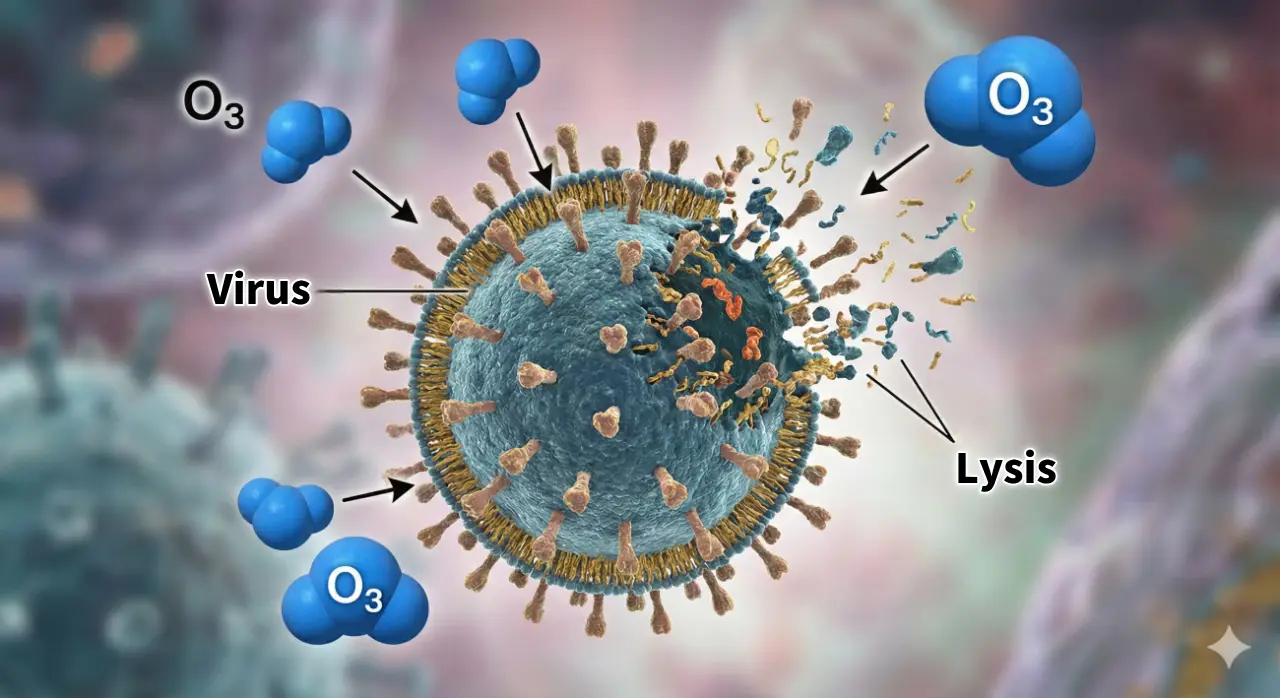
The moment ozone touches the cell membrane of a bacterium or the outer shell (envelope) of a virus, it instantly decomposes proteins and lipids into pieces with its powerful oxidizing power, considered to be about 7 times that of sodium hypochlorite. This is called “lysis."
Because it destroys the cell shell itself, causing the contents to leak out, the bacteria cannot survive, and viruses lose their infectivity (inactivation). To give an analogy, it is like popping a balloon with a needle rather than deflating it with poison.
[Why Ozone is Considered the Strongest]
Because it physically destroys the structure, it gives no chance for “resistant bacteria," which evolve to have resistance to drugs, to be born. This is the scientific basis for why ozone can stably exert its effects against a wide variety of bacteria and viruses.
Process of Destruction by Oxidation
1. Ozone adsorbs to the surface
2. Oxidizes, decomposes, and destroys the cell membrane
3. Bacteria are eliminated; ozone reverts to oxygen
● Physical Destruction Called “Lysis"
The moment ozone touches the cell membrane of a bacterium or the outer shell (envelope) of a virus, its powerful oxidizing power decomposes proteins and lipids into pieces. This is called “lysis."
Because it destroys the cell shell itself, causing the contents to leak out, the bacteria cannot survive, and viruses lose their infectivity (inactivation). To give an analogy, it is like popping a balloon with a needle rather than deflating it with poison.
[Why Ozone is Considered the Strongest]
Because it physically destroys the structure, it gives no chance for “resistant bacteria," which evolve to have resistance to drugs, to be born. This is the scientific basis for why ozone can stably exert its effects against a wide variety of bacteria and viruses.
3. Evidence-Based Sterilization Power: Virus Inactivation Empirical Data
The effect of ozone is not mere “theory." Its sterilization and inactivation effects have been proven by rigorous tests at universities and research institutions domestically and internationally. Here, we introduce empirical data from highly scrutinized public institutions.
Inactivation of the Novel Coronavirus (SARS-CoV-2)
In 2020, a research group at Nara Medical University confirmed the “inactivation of the novel coronavirus by ozone gas" for the first time in the world. This research scientifically proved that exposure to a certain concentration of ozone gas reduces the virus’s infectivity to a maximum of 1/10,000 (over 99.9%).
Source: Nara Medical University (Demonstration experiment results based on the MBT: Medicine Based Town concept)
● Overwhelming Superiority Against Resistant Bacteria and Hard-to-Control Viruses
Ozone’s greatest strength lies in its attack method being “physical destruction." Because of this, it exhibits exceptionally high efficacy without exception against “multi-drug resistant bacteria" that have acquired drug resistance through evolution, and “non-enveloped viruses" that are resistant to alcohol.
- ✅ MRSA / VRE (Multi-Drug Resistant Bacteria)Ozone physically crushes the cell membranes of resistant bacteria that many antibiotics cannot affect, such as Methicillin-resistant Staphylococcus aureus (MRSA) and Vancomycin-resistant Enterococci (VRE).
- ✅ MRSE (Methicillin-resistant Staphylococcus epidermidis)MRSE is a major cause of nosocomial infections. Spatial cleaning with ozone builds an environment where these hard-to-control bacteria cannot survive, physically breaking the chain of infection.
- ✅ Norovirus / InfluenzaIt completely deprives norovirus, which alcohol struggles to affect, and influenza, which constantly changes types, of their infectivity by oxidatively decomposing (inactivating) their outer shells.
- ✅ General Bacteria / Mold FungiFrom E. coli, Salmonella, Legionella, to black mold spores. Because it is a physical attack that pierces the “shell," it can suppress all kinds of pathogens.
What is the Sterilization Power Indicator “CT Value"?
Concentration (ppm) × Time (min)
The sterilization effect of ozone is determined by the product of “concentration" and “time." AIC Co., Ltd.’s equipment meticulously calculates this CT value to create a safe and reliable sterilized space.
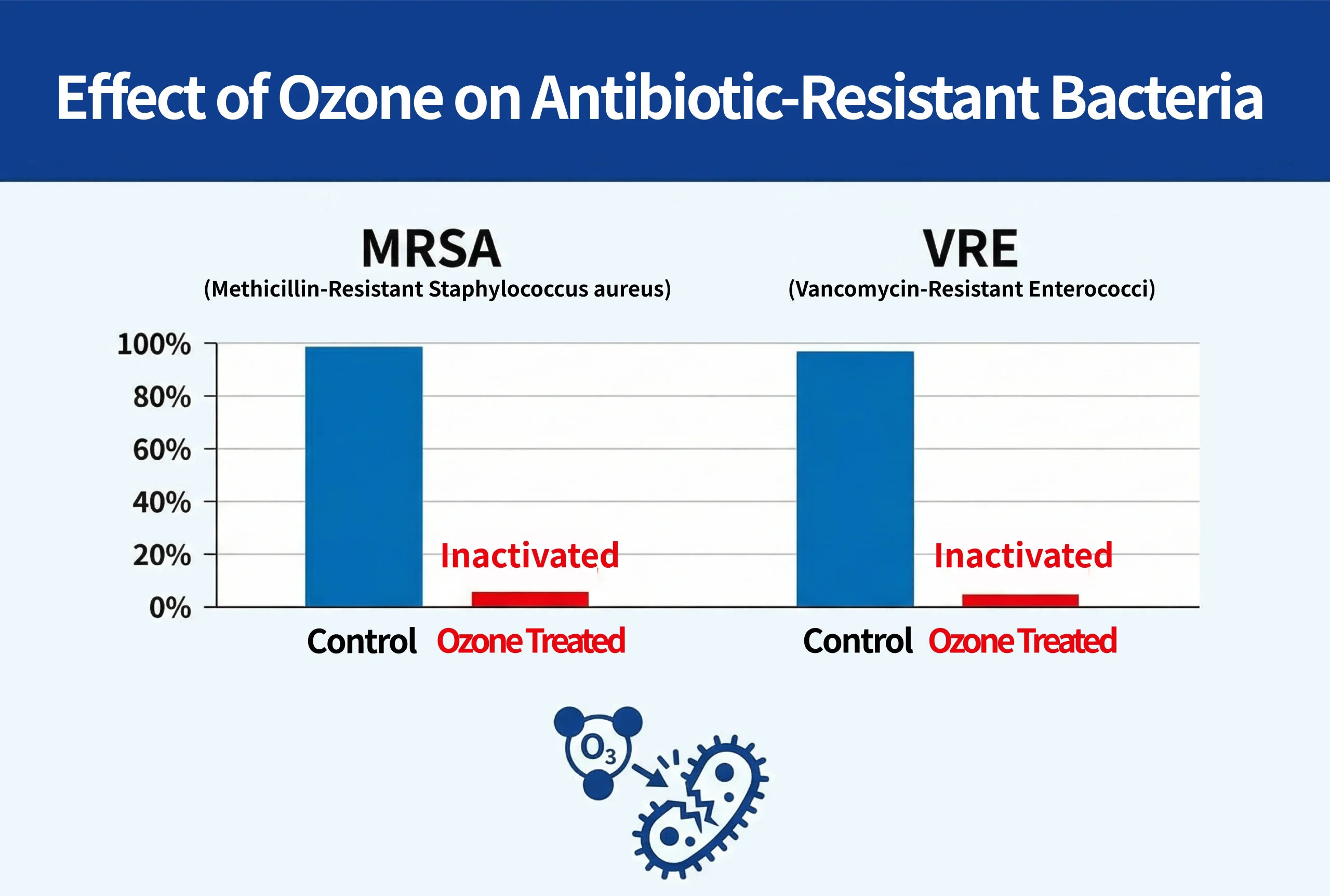
*Source: Created based on the Japan Ozone Association’s “Ozone Utilization Guide" and domestic public university research empirical data
There are many sterilization products in the world, but what matters is specific evidence: “At what concentration and in how many minutes was it actually effective against that virus?" The data provided by AIC Co., Ltd. are facts derived entirely under rigorous test environments. These “unfalsifiable figures" are exactly why AIC’s ozone continues to be chosen by government agencies and medical institutions.
Inactivation of the Novel Coronavirus (SARS-CoV-2)
In 2020, a research group at Nara Medical University confirmed the “inactivation of the novel coronavirus by ozone gas" for the first time in the world. This research scientifically proved that exposure to a certain concentration of ozone gas reduces the virus’s infectivity to a maximum of 1/10,000 (over 99.9%).
Source: Nara Medical University (Demonstration experiment results based on the MBT concept)
● Overwhelming Superiority Against Resistant Bacteria and Hard-to-Control Viruses
Ozone’s greatest strength lies in its attack method being “physical destruction." Because of this, it exhibits exceptionally high efficacy without exception against “multi-drug resistant bacteria" that have acquired drug resistance through evolution, and “non-enveloped viruses" that are resistant to alcohol.
- ✅ MRSA / VRE (Multi-Drug Resistant Bacteria)
Ozone physically crushes the cell membranes of resistant bacteria that many antibiotics cannot affect, such as Methicillin-resistant Staphylococcus aureus (MRSA) and Vancomycin-resistant Enterococci (VRE). - ✅ MRSE (Methicillin-resistant Staphylococcus epidermidis)
MRSE is a major cause of nosocomial infections. Spatial cleaning with ozone builds an environment where these hard-to-control bacteria cannot survive, physically breaking the chain of infection. - ✅ Norovirus / Influenza
It completely deprives norovirus, which alcohol struggles to affect, and influenza, which constantly changes types, of their infectivity by oxidatively decomposing (inactivating) their outer shells. - ✅ General Bacteria / Mold Fungi
From E. coli, Salmonella, Legionella, to black mold spores. Because it is a physical attack that pierces the “shell," it can suppress all kinds of pathogens.
What is the Sterilization Power Indicator “CT Value"?
Concentration (ppm) × Time (min)
The sterilization effect of ozone is determined by the product of “concentration" and “time." AIC Co., Ltd.’s equipment meticulously calculates this CT value to create a safe and reliable sterilized space.
*Source: Created based on the Japan Ozone Association’s “Ozone Utilization Guide" and domestic public university research empirical data
There are many sterilization products in the world, but what matters is specific evidence: “At what concentration and in how many minutes was it actually effective against that virus?" The data provided by AIC Co., Ltd. are facts derived entirely under rigorous test environments. These “unfalsifiable figures" are exactly why AIC’s ozone continues to be chosen by government agencies and medical institutions.
What is the Difference Between Ion Emission and Ozone Methods?
Products claiming to have “sterilization effects" are broadly divided into two methods. Properly understanding the characteristics of each is the first step to reliable hygiene management.
| Comparison Item | Ion Emission Method | Ozone Oxidation Method |
|---|---|---|
| Mechanism of Sterilization & Deodorization | Adheres particles to suppress activity (Suppression) | Directly oxidizes and decomposes the cell membrane (Bacteriolysis) |
| Spatial Reach | Short lifespan makes it hard to reach far | Diffuses into every corner of the room as a gas |
| Main Adoption Sites | Homes, general home appliances, etc. | Hospitals, food factories, water treatment plants (Professional settings) |
Specialist’s Perspective: Why Professionals Choose “Ozone"
While “ions" show a certain effect mainly against airborne bacteria, “ozone" with its powerful oxidizing power is suitable for completely eliminating bacteria and odors adhered to wallpapers and furniture. Especially in sites requiring a high level of hygiene management, such as the disinfection standards set by the Ministry of Health, Labour and Welfare, ozone is adopted as standard because its “reliability" is scientifically proven.
4. Is Ozone Harmful? About Toxicity and Impact on the Human Body
To the questions, “Is ozone harmful to the human body?" or “Does it have a specific toxicity or danger?", our answer as specialists is clear. As long as “concentration management" is appropriate, there is no sterilization method as safe and clean as ozone. In fact, we constantly spend time with ozone in our daily lives.
● Surprisingly Unknown “Familiar Ozone Concentrations"
Ozone is not a special substance; about 0.05 ppm of ozone constantly exists in forests, and about 0.03 to 0.06 ppm on coasts. The true identity of the “refreshing" air you feel when forest bathing is actually the self-purification action of trace amounts of ozone.
The occupational exposure limit set by the Japan Society for Occupational Health is “0.1 ppm". This is the official safety standard value, recognized as having no health impact even if working in that environment for 8 hours a day, 40 hours a week.
[Guide to Ozone Concentration and Environment]
– 0.05 ppm: Average concentration in forests and coasts
– 0.1 ppm: Japan’s safety standard value (Exposure limit)
● The Nose Becomes a “Safety Alert"
A major advantage of ozone is that “humans can detect its presence at extremely low concentrations." Humans can sense a “distinctive smell" at 0.01 ppm, which is 1/10th of the safety standard value.
In other words, long before it affects the body, anyone can notice that “ozone is being emitted," providing a level of “ease of self-defense" incomparable to odorless chemicals or gases.
[Please Rest Assured]
Smelling ozone does NOT mean danger. There is a safety margin of more than 10 times between the “level where you can smell it" and the “level where it affects health."
Since 2006, we have consistently pursued “safe ozone utilization." The equipment provided by AIC Co., Ltd. (such as the BT-180H) is equipped with high-precision ozone sensors and motion sensors as standard. It maintains a concentration below the safety standard (0.1 ppm) while people are present, and instantly switches to a powerful sterilization mode when people leave. This “intelligent control" is the biggest reason why AIC has been trusted by medical institutions, fire stations, and kindergartens for many years, continuing a record of zero accidents.
● Surprisingly Unknown “Familiar Ozone Concentrations"
Ozone is not a special substance; about 0.05 ppm of ozone constantly exists in forests, and about 0.03 to 0.06 ppm on coasts. The true identity of the “refreshing" air you feel when forest bathing is actually the self-purification action of trace amounts of ozone.
The occupational exposure limit set by the Japan Society for Occupational Health is “0.1 ppm". This is the official safety standard value, recognized as having no health impact even if working in that environment for 8 hours a day, 40 hours a week.
[Guide to Ozone Concentration and Environment]
– 0.05 ppm: Average concentration in forests and coasts
– 0.1 ppm: Japan’s safety standard value (Exposure limit)
● The Nose Becomes a “Safety Alert"
A major advantage of ozone is that “humans can detect its presence at extremely low concentrations." Humans can sense a “distinctive smell" at 0.01 ppm, which is 1/10th of the safety standard value.
In other words, long before it affects the body, anyone can notice that “ozone is being emitted," providing a level of “ease of self-defense" incomparable to odorless chemicals or gases.
[Please Rest Assured]
Smelling ozone does NOT mean danger. There is a safety margin of more than 10 times between the “level where you can smell it" and the “level where it affects health."
Since 2006, we have consistently pursued “safe ozone utilization." The equipment provided by AIC Co., Ltd. (such as the BT-180H) is equipped with high-precision ozone sensors and motion sensors as standard. It maintains a concentration below the safety standard (0.1 ppm) while people are present, and instantly switches to a powerful sterilization mode when people leave. This “intelligent control" is the biggest reason why AIC has been trusted by medical institutions, fire stations, and kindergartens for many years, continuing a record of zero accidents.
Medically Proven, State-of-the-Art Ozone Sterilization.
In theory, ozone has long been known to have high sterilization power. However, in recent years, it has been proven for the first time in the world as “medical evidence" to inactivate specific viruses.
“To the safest place where you want to take a deep breath."
Click here for details on the latest model with medical empirical data.
Medically Proven, State-of-the-Art Ozone Sterilization.
In theory, ozone has long been known to have high sterilization power. However, in recent years, it has been proven for the first time in the world as “medical evidence" to inactivate specific viruses.
“To the safest place where you want to take a deep breath."
Click here for details on the latest model with medical empirical data.
5. Evidence Supporting Reliability (Empirical Data & Reference Literature)
The sterilization and inactivation effects of ozone and its safety explained on this page are based on demonstration experiments and guidelines by the following public institutions and academic organizations. Since the start of ozone product sales in 2006, AIC Co., Ltd. has strived to provide accurate information based on these latest findings.
Demonstration of Virus Inactivation
- ● Fujita Health University (August 2020)
Press release and academic paper on “World’s first demonstration of novel coronavirus inactivation by low-concentration ozone gas." - ● Nara Medical University (May 2020)
Research report on “Confirmation of novel coronavirus inactivation by high-concentration ozone gas exposure." - ● National Hospital Organization Sendai Medical Center
A series of clinical studies on “Verification of the effect of ozone gas against viruses on environmental surfaces."
Sterilization of Resistant and General Bacteria
- ● Japanese Society of Ozone Therapy / Japan Ozone Association
Papers on the oxidative destruction effect against MRSA (Methicillin-resistant Staphylococcus aureus) and VRE (Vancomycin-resistant Enterococci). - ● Tokyo Metropolitan Industrial Technology Research Institute
Sterilization performance test results of general bacteria (E. coli, Staphylococcus, etc.) by ozone generators. - ● Ministry of Health, Labour and Welfare Guidelines
Guidelines for utilizing ozone water and ozone gas for disinfecting equipment and environments in the “Hygiene Management Manual for Large-Scale Cooking Facilities."
Public Standards for Safety and Exposure Limits
Regarding the safety of ozone, we comply with the following official exposure limit standards and provide equipment design and operational guidance.
- Japan Society for Occupational Health: Stipulates “0.1 ppm (8-hour time-weighted average)" as the occupational exposure limit.
- Japan Air Cleaning Association: Recommends the safety standard for indoor ozone concentration to be “0.05 ppm or less."
- FDA (U.S. Food and Drug Administration): Stipulates the permissible limit for indoor ozone concentration in medical devices.
In today’s era of information overflow, what matters most is “scientific truth."
All products and services provided by AIC Co., Ltd. are built upon this rigorous evidence.
Over 20 years of unwavering trust from medical and firefighting frontlines.
The reason lies in these “unfalsifiable figures."
Basic Knowledge of Ozone: Frequently Asked Questions (FAQ) on Safety and Impact on the Human Body
Conclusion: Creating a “Future Where You Can Breathe Deeply" with Ozone
How was it? If understood and controlled correctly, ozone becomes the “strongest ally" against bacteria and viruses that threaten our daily lives.
1. Pursuit of Scientific Evidence
Rather than “it somehow works," we only make proposals based on empirical data proven by domestic and international universities and research institutions.
2. Thorough Safety
Leveraging our knowledge since 2006, we guarantee 24-hour peace of mind with advanced control technology that strictly adheres to public standards (0.1 ppm).
3. Optimal Solutions Tailored to the Site
From medical facilities to restaurants and ordinary homes, our experts will individually propose the optimal CT value and installation plan suited to the environment.
To everyone who wants to turn air-related anxiety into peace of mind.
Whether considering the introduction of ozone products, questions about the installation environment, or specific countermeasures against bacteria and viruses, please consult AIC’s specialists about anything. We will answer sincerely with our 20 years of track record and the latest evidence.
Article Supervision
Since 2006, we have been pursuing ozone technology at the forefront of infection control. Based on the manufacturer’s technology whose effectiveness has been demonstrated in joint research with Nara Medical University and Fujita Health University, we are promoting correct hygiene management backed by scientific evidence to medical and public institutions across Japan.