


ROI of Commercial Food Waste Disposers | Cost Reduction Guide | AIC
To Executives & Decision Makers: Turning a Cost Center into a Profit Center
Why Should You Introduce a Commercial Food Waste Disposer Now?
The ROI of the “Extinction Type" that Solves Management Issues
A massive amount of food waste (commercial general waste) is generated daily in restaurants, welfare facilities, food factories, and more. Are you overlooking this as a “necessary expense that is natural to pay every month"?
With the business environment changing drastically due to soaring industrial waste disposal costs, severe labor shortages, and environmental compliance (SDGs) required of companies, in-house processing of food waste is an “urgent management issue."
In this article, we explain the specific benefits and the Return on Investment (ROI) that management should know regarding the “extinction-type food waste disposer," which is attracting attention not simply as a trash can substitute, but as a capital investment that generates profit.
3 Reasons Why Commercial Food Waste Disposers are Chosen as a Management Strategy
1. Overwhelming Reduction in Disposal Costs (Fixed Costs)
The processing costs for commercial food waste are on an upward trend year by year. About 80% of food waste is “moisture," meaning we are paying high transportation fees just to transport “water." By processing (extinguishing) it on-site with a disposer, this wasteful cost is drastically compressed.
- Cut Collection Costs: Reduce monthly waste transportation and disposal costs by hundreds of thousands to millions of yen annually.
- Improve Profit Margins: The reduced expenses directly add to operating profit, having the same impact as an increase in sales.
- Reliable Investment Recovery: Through lease introduction, there are many cases where “cost reduction amount > lease fee" from the very first month, improving cash flow.
2. Improvement of the Work Environment and Countermeasures for “Labor Shortages"
Transporting and storing heavy, foul-smelling food waste is a major stress for employees (dirty, dangerous, and demanding work) and a hidden cause of turnover. Removing this burden from the workplace serves as a powerful employee retention measure in an era of hiring difficulties.
- Focus on Core Tasks: Reduce the time spent taking out the trash and shift resources to highly productive tasks like customer service and manufacturing.
- Prevent Turnover & Improve Retention: Prevent the generation of bad odors and pests, providing a clean and comfortable work environment.
- Eliminate Hygiene Risks (Infections): By not accumulating garbage within the facility, serious management risks such as mass infections and foreign matter contamination are prevented proactively.
3. Concrete Contributions to SDGs and ESG Management
“Not burning garbage" is the most effective decarbonization action a company can take immediately. A stance on environmental consideration directly leads to improved evaluations from business partners and increased corporate value as a target for ESG investment.
- Significant CO2 Reduction: Avoid the incineration of moisture-rich food waste, achieving zero emissions.
- Enhancement of Corporate Value: Can be clearly highlighted in environmental reports as a contribution to SDGs “Goal 12 (Responsible Consumption and Production)" and “Goal 13 (Climate Action)."
Differences in Processing Methods and Why the “Extinction Type" is Mainstream
There are several methods for food waste disposers, but considering the operational burden on the site and running costs,
the “extinction type" is currently the overwhelming mainstream choice.
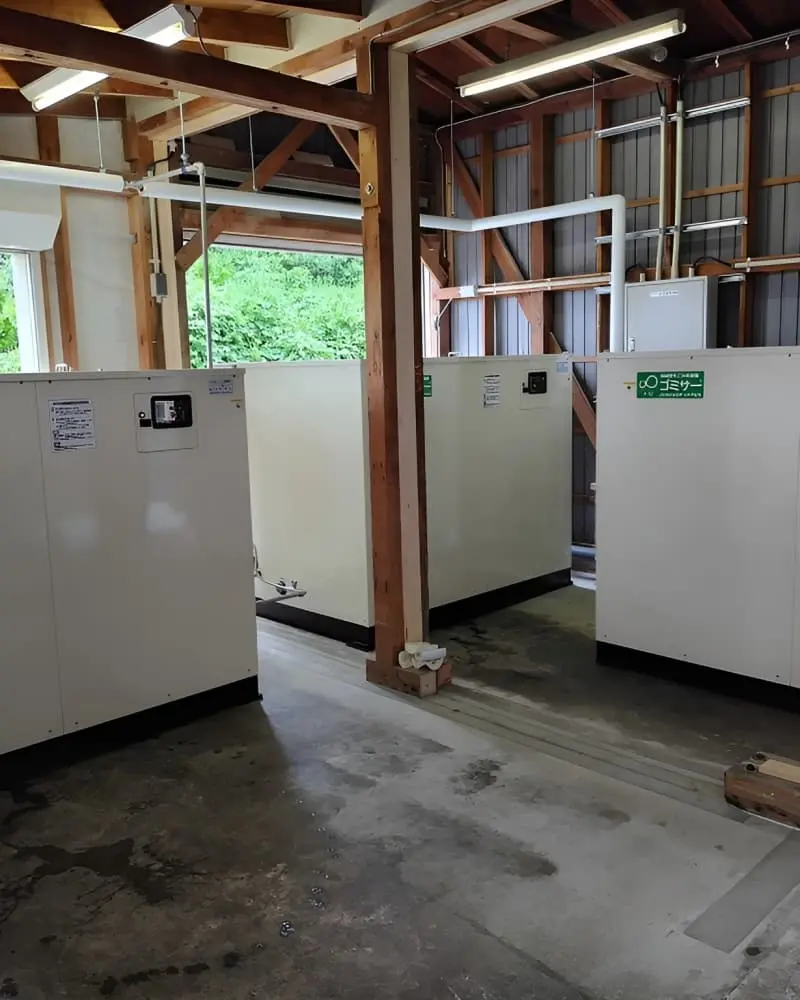
✨ Extinction Type (GOMISER)
Decomposes food waste 99.9% into “water and carbon dioxide gas" using the power of microbes. Because no residue remains, there is absolutely no effort required to extract or dispose of compost. Electricity costs are low, making it the easiest method to operate.
△ Composting Type (Bio-type)
A type that turns food waste into compost. While suitable for facilities where composting is the goal, there are many cases where there is no one to take the resulting compost, leading to situations where money is paid to dispose of it as industrial waste (involving the heavy labor of extraction).
△ Drying Type
A type that evaporates moisture with hot air. Although the volume is reduced, it consumes a massive amount of energy (electricity, gas, etc.) to dry the waste, resulting in extremely high running costs.
\ Once the method is decided, next is “Choosing the Model" /
[Commercial Food Waste Disposer] 6 Selection Points to Avoid Mistakes
We explain the truths that manufacturers do not tell you, such as the “difference between catalog processing capacity and measured values," using a comparison table.
Introduction Case Studies of the “Extinction Type" that Solved Management Issues
Nursing Facilities & Hospitals
Elimination of Infection Risks and Prevention of Cleaning Staff Turnover
[Issue] Combined with waste such as diapers, bad odors and infection risks at the garbage area became a problem. The retention rate of cleaning staff was also poor due to the transport of heavy food waste.
[Result] By introducing GOMISER, generated food waste could be instantly extinguished and processed within the kitchen. The odor problem was completely resolved, and the elimination of heavy labor significantly improved the staff retention rate.
Food Factories & Company Cafeterias
Reduction of High Electricity Bills and Achievement of the “Ultimate SDGs"
[Issue] Enormous electricity bills from old drying-type disposers were squeezing profits. Also, they were looking for the “next move" to achieve company-wide SDGs goals.
[Result] By replacing it with an extinction type that utilizes microbial heat, running costs dropped drastically. Furthermore, the “CO2 reduction effect due to eliminating incineration" was quantified, allowing it to be highlighted to shareholders and business partners as a centerpiece measure in the environmental report.
Hotels & Restaurants
Operational Efficiency through “Zeroing" Residue Extraction
[Issue] With the previously introduced composting-type disposer, the heavy labor of regularly shoveling out the resulting compost occurred, and it eventually fell out of use.
[Result] Changed to GOMISER, which produces no residue. Because waste can be continually added 24 hours a day without the need for draining water, on-site staff happily use it, leading to a reliable reduction in industrial waste outsourcing costs.
Request a Free ROI Simulation to Maximize Cost Reduction
The Return on Investment (ROI) period for introducing an extinction-type food waste disposer varies depending on the current waste disposal costs and utility bills at your facility.
We provide free customized simulation data that clearly shows “how much cost can be reduced" and “how many years it will take to recover the investment." Please feel free to use this as material for internal approval by management.
Request a Free ROI Simulation / Quote
Product Lineup (Extinction Type GOMISER)
We will propose the optimal model from compact machines to large-scale machines according to the amount of food waste discharged (scale) at the site. *The following is an example of our lineup.
| Model | Processing Capacity (Per Day) | Power Supply | Approx. Target Facilities |
|---|---|---|---|
| GH10 | 7–10 kg | Single-phase 100V | Nursery schools (Up to ~60 people) |
| GH50 | 30–50 kg | Three-phase 200V | Company cafeterias (Up to ~300 people) |
| GH250 | 200–250 kg | Three-phase 200V | Hospitals / Nursing facilities (Up to ~500 beds) |
| GH750 | 700–750 kg | Three-phase 200V | Large-scale facilities (Up to ~1,500 beds) |
[Summary] Reasons to Introduce a Commercial Food Waste Disposer (Extinction Type)
Food waste disposal is no longer “just a cost," but a “strategic capital investment" to solve management issues. Replacing with or introducing the extinction-type “GOMISER" guarantees the following four returns.
- 📉 Fundamental reduction of soaring industrial waste and electricity costs (Improvement of profit margins)
- 🧹 Prevention of “labor shortages and turnover" by eliminating bad odors and heavy labor
- 🌍 Achievement of SDGs (ESG Management) through CO2 reduction and zero emissions
- 💰 Smart funding utilizing national and local “subsidies and grants"
*In particular, the highest return on investment is achieved when replacing old disposers (composting or drying types) whose manufacturers have gone bankrupt.
Frequently Asked Questions from Decision Makers (Q&A)
There are many cases where the monthly “reduction in processing and transportation costs paid to industrial waste contractors" exceeds the “monthly lease fee," making introduction possible without putting pressure on cash flow. We will present specific recovery years through a free simulation.
With the composting type, there is often no one to take the resulting compost, ending up in paying money to dispose of it as industrial waste, and it also tends to generate the heavy labor of shoveling out heavy compost. Because the extinction-type “GOMISER" decomposes food waste 99.9% into water and carbon dioxide gas, it fundamentally reduces such “effort and cost required for post-processing."
Unlike manufacturers that entered during past booms and then withdrew, we have established a solid support system as a pioneer in food waste disposers. The fact that the structure is simple and hard to break is also a reason why we have continued to be chosen for many years.
The fact that “food waste generated in-house is processed within the company without incineration (without emitting CO2)" directly connects to Goal 12 and Goal 13 of the SDGs. It is highly effective as material for appeal in environmental reports, corporate websites, and recruitment activities.
Currently Offering Free Cost Reduction Simulations
“How many years will it take to recoup the investment if introduced to our company?" “Are there any subsidies available?"
We will create specific simulation materials free of charge that can be used directly for approvals and explanations to management.
First, please let us know your current food waste discharge volume (industrial waste costs).
Click Here for Introduction Consultations and Free Estimates