


[Complete Guide] Commercial Sterilization & Deodorization Tech Comparison | AIC
SPECIALIST COLUMN
[Complete Guide] Thorough Comparison of Commercial Sterilization & Deodorization Technologies
– Differences Between Ozone, Hypochlorous Acid, and Air Purifiers, and How to Choose Correctly –
Are you choosing equipment for infection control and odor problems based on a “vague feeling"? The optimal solution varies depending on the application, but in conclusion, if you want to achieve both “reliable sterilization and deodorization of the entire space" and “reduction of labor costs (effort)," ozone is the most superior choice.
In this article, AIC, an ozone specialist observing the front lines since 2006, objectively and thoroughly compares and explains the differences between major sterilization and deodorization technologies.
Understand in 30 Seconds! The Conclusion of This Article
- ✅ Ozone Method: For workplaces that want to completely eliminate adhering bacteria and odors throughout the entire space (even behind walls and furniture) from the root. Zero chemical costs and zero effort.
- ✅ Hypochlorous Acid Water: For cases where you want to easily sterilize only the area around the machine (beware of the effort to replenish the liquid and metal corrosion).
- ✅ Air Purifiers: For cases where you want to filter out only “dust and pollen" in the air in an environment with people (unsuitable for adhering bacteria).
1. [At a Glance] Comparison of Major Sterilization & Deodorization Technologies
Each sterilization and deodorization technology has its strengths and weaknesses. Please use this as a standard to choose the most reliable and efficient method according to your company’s environment and resources (budget and manpower).
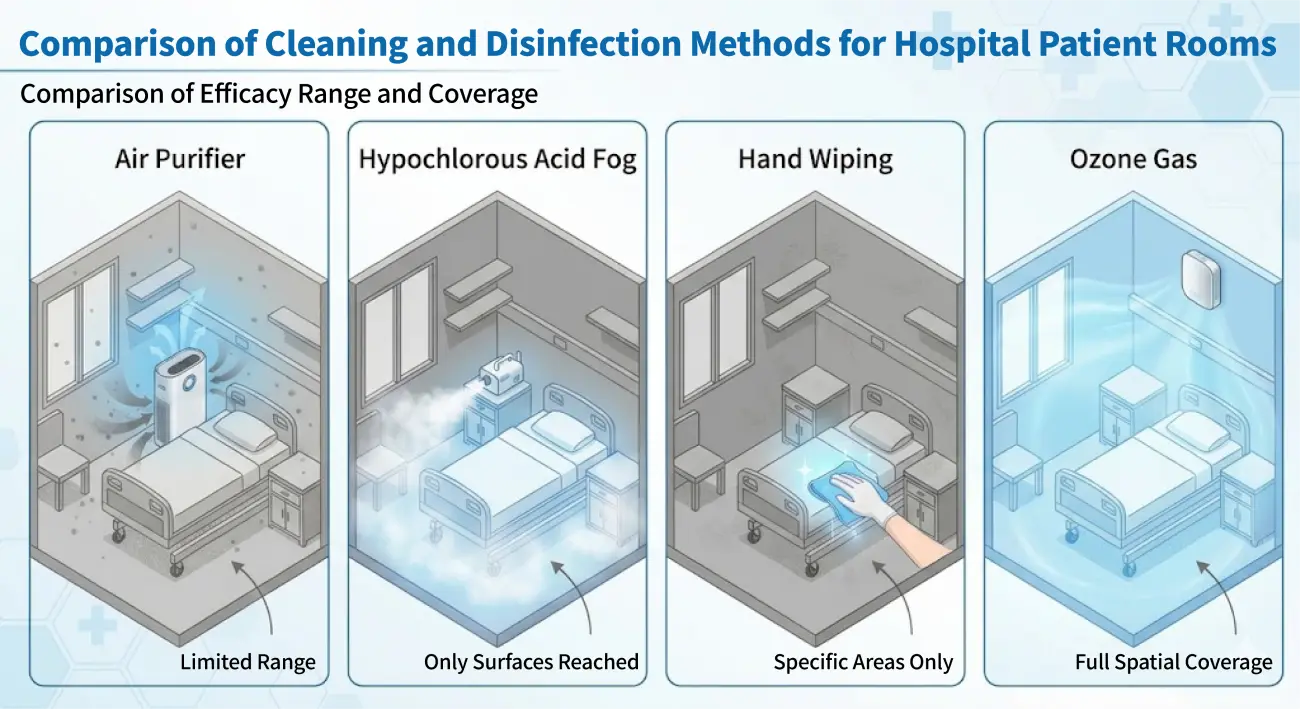
▲ Differences in spatial accessibility by each technology. Only ozone, as a gas, reaches every corner.
| Comparison Item | Ozone Gas (AIC Method) |
Hypochlorous Acid Water (Spatial Spraying) |
Air Purifier (Filter/Ion) |
Manual Wiping (Alcohol, etc.) |
|---|---|---|---|---|
| Spatial Accessibility (Does it reach every corner?) |
◎ Fills every corner of the room as a gas |
◯ Area reached by the mist (Prone to unevenness) |
△ Only the air drawn into the machine |
× Only wiped areas (Physical limit) |
| Effect on Adhering Bacteria & Odors | ◎ Directly oxidizes and decomposes even behind walls and furniture |
◯ Certain effect if the adhered moisture touches it |
△ Strong against airborne bacteria but weak against adhering matter |
◎ High reliability if wiped directly |
| Residue & Safety (Post-processing effort) |
◎ Reverts to oxygen after reaction. Absolutely no wiping required. |
△ Components remain. Concerns about metal corrosion. |
◎ No residue in the space due to filter dust collection. |
◯ Volatilizes, but concerns about discoloration depending on the material. |
| Running Costs (Replenishment & Consumables) |
◎ The raw material is “air". Zero chemical costs. |
△ Requires continuous purchase of dedicated liquid agents. |
△ Periodic filter replacement costs. |
△ Continuous consumable costs for alcohol, paper, etc. |
| Staff Labor (Automation & Effort) |
◎ Fully automatic operation with sensors and timers. |
△ Effort to dilute/replenish liquid and clean the tank. |
◯ Operation is automatic, but cleaning & maintenance are required. |
× Overwhelming labor costs. Risk of leaving unwiped spots. |
The Biggest Reason Professionals Introduce “Ozone"
In workplaces pressed by daily tasks, “anyone can achieve even and reliable sterilization" and “not increasing the staff’s workload (costs)" are absolute requirements. Although ozone equipment requires an initial investment, since it continues to work automatically using “air" as a raw material after introduction, it offers the highest cost performance when viewed over months or years, realizing reliable hygiene management without human error (e.g., forgetting to wipe).
2. Features, Pros, and Cons of Each Technology
① Hypochlorous Acid Water (Spatial Spraying)
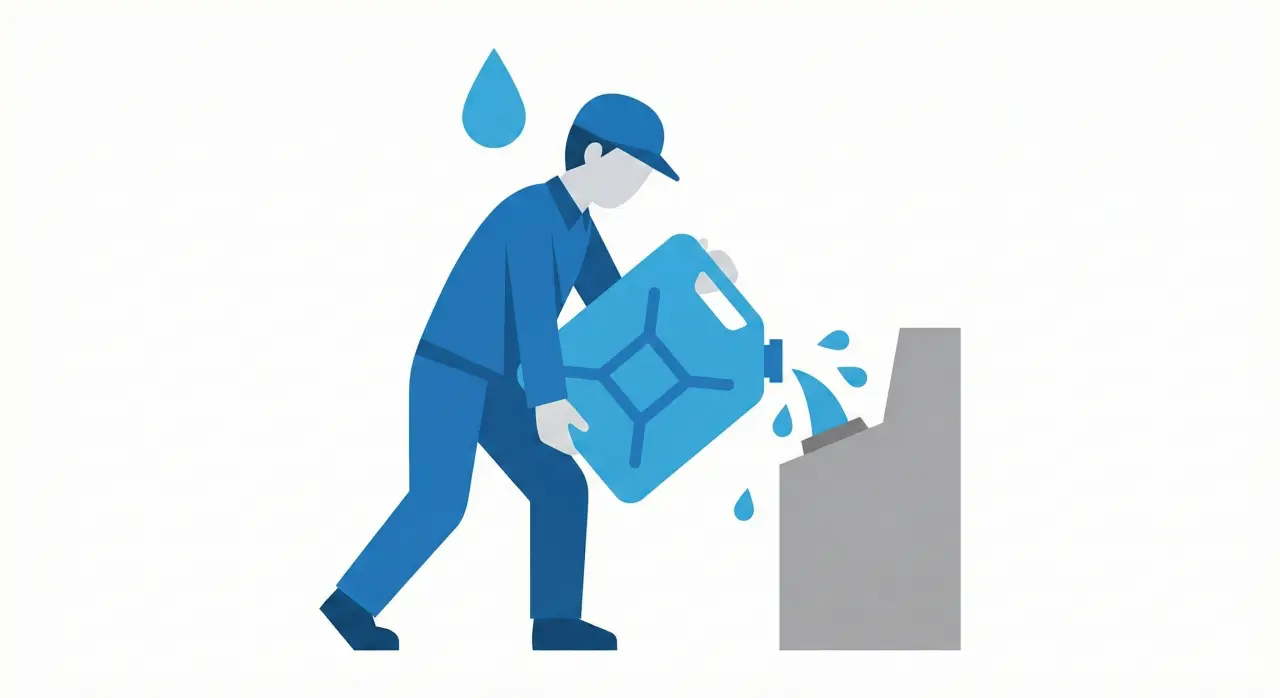
This method sprays a dedicated liquid agent into the space as a mist. Although the sterilization power itself is high, there are inevitably operational hurdles due to the nature of the liquid.
Pros:
・Exerts a high sterilization effect if the liquid agent firmly hits the target.
・Can be introduced even with relatively inexpensive sprayers.
Cons:
・Requires daily effort such as periodic purchase of liquid agents, dilution, and replenishment to the tank.
・Because moisture falls, it easily causes rust (corrosion) on precision equipment and metals.
② Air Purifier (Filter / Ion Emission)
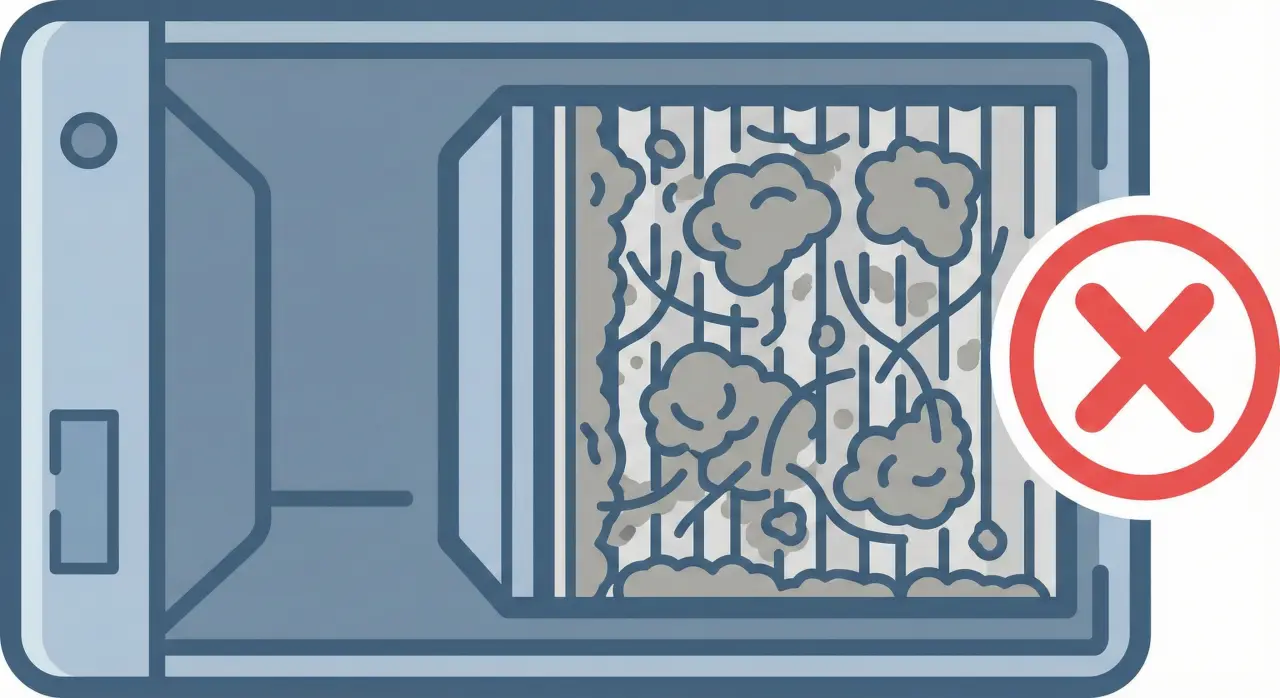
This method draws air into the machine and filters it out. It is the ultimate tool against “visible particles" such as dust and pollen.
Pros:
・Can always operate safely in environments with people.
・Extremely strong at collecting dust, pollen, PM2.5, etc.
Cons:
・Only effective on the air drawn into the machine.
・Weak effect against bacteria and odor sources adhering to walls and desks (passive).
③ Ozone Gas (AIC Method)
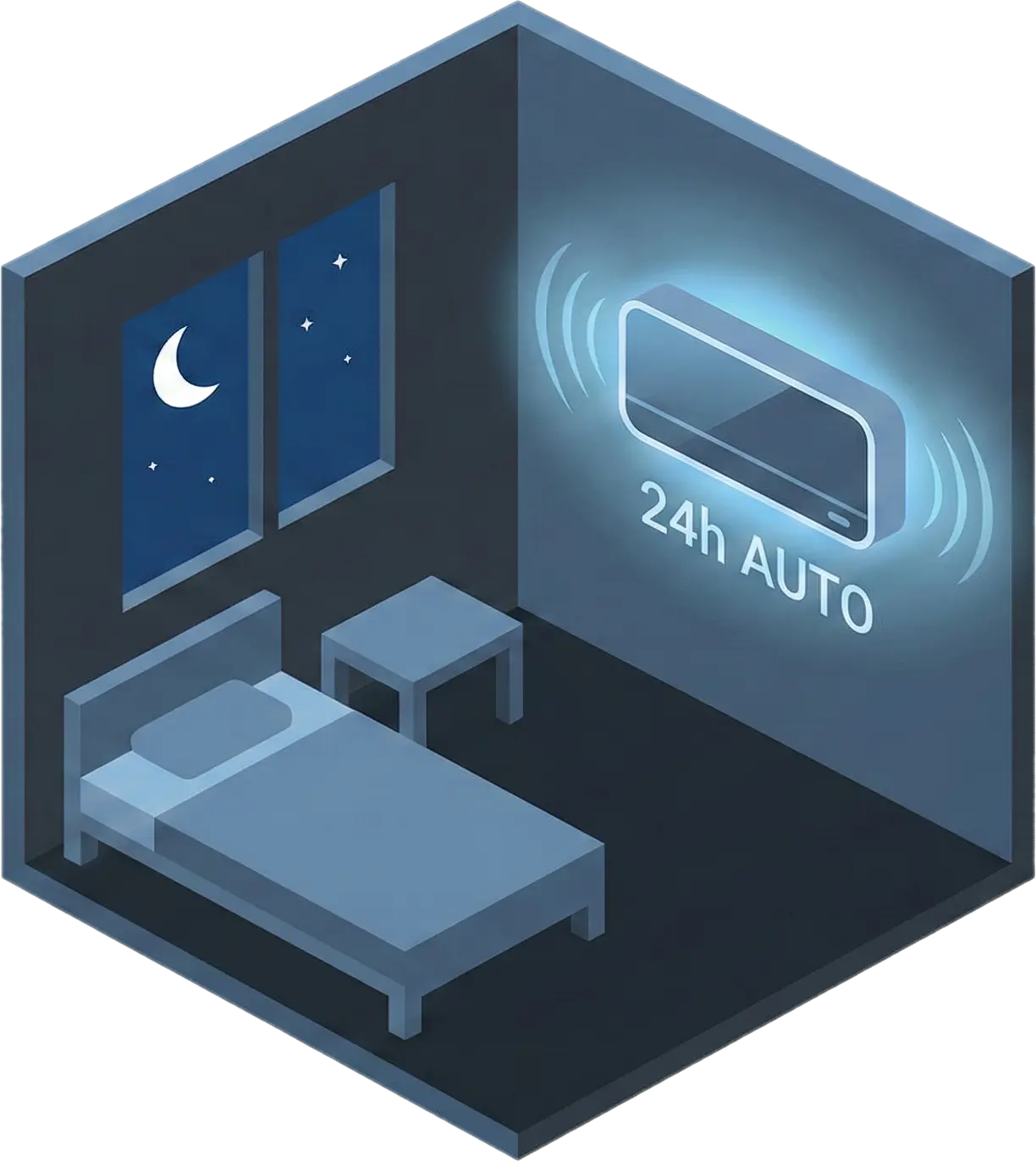
This method fills the space with gaseous ozone and directly “oxidizes and decomposes (destroys)" the source of bacteria and odors. It is the most trusted technology in professional settings.
Pros:
・As a gas, it enters every corner of the room (even behind furniture) and directly destroys even adhering bacteria.
・Since it reverts to oxygen after reaction, there is zero residue (no wiping required).
・Because the raw material is air, there are zero chemical costs and zero replenishment effort (only operating electricity costs, about a few dozen yen per day).
Cons (Points to Note):
・Concentration management (below the national safety standard of 0.1 ppm) is required in environments with people.
=> AIC’s equipment solves this problem with “fully automatic control by high-precision sensors," realizing 24-hour safe operation.
3. Avoid Mistakes! “3 Criteria" for Choosing Equipment Taught by Professionals
To find the optimal method for your company, it is certain to narrow down using the following 3 criteria.
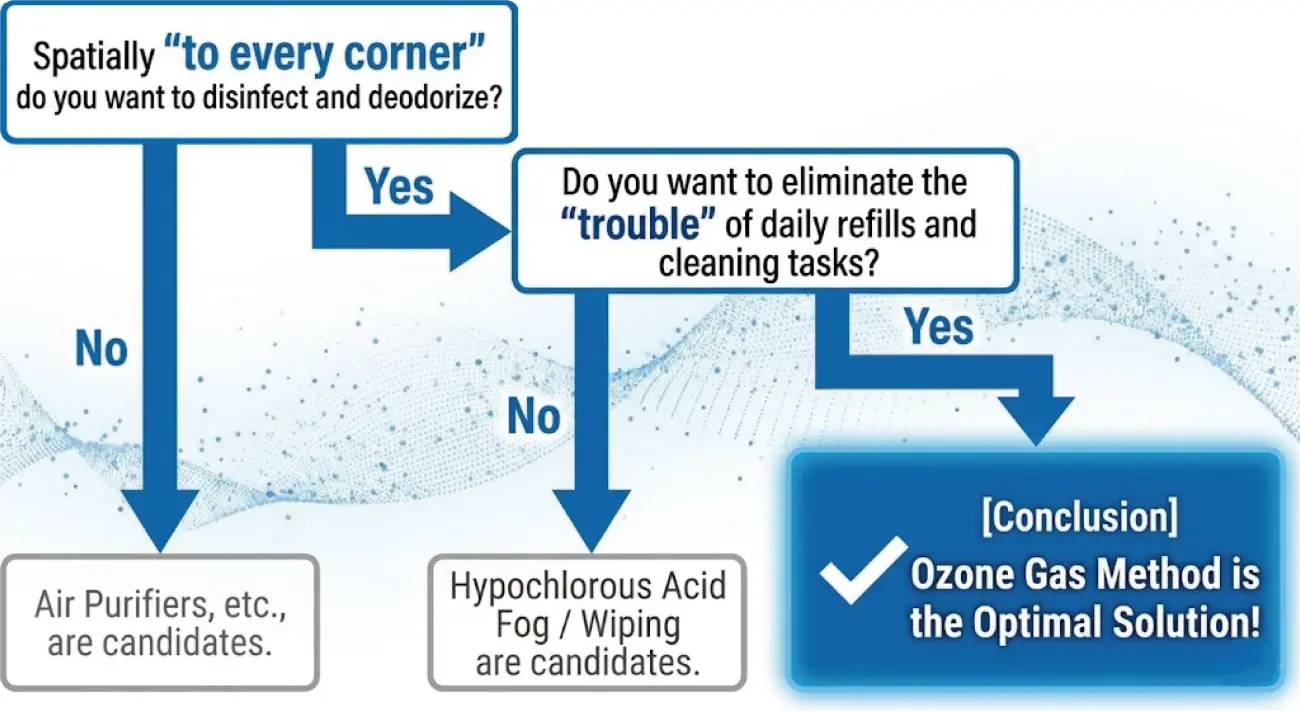
Criterion 1: Only “Air" or “Entire Space (Walls & Furniture)"?
If you want to capture suspended dust and pollen, an “air purifier" is suitable. However, if you want to fundamentally eliminate “adhering bacteria" and “ingrained odors" sticking to walls, doorknobs, and behind furniture, “ozone," which diffuses as a gas, is essential.
Criterion 2: Running Costs and Staff “Effort"
While hypochlorous acid and alcohol wiping have low introduction costs, the subsequent “cost of purchasing liquids" and “staff working time (labor costs)" will continue forever. Because ozone continues to work automatically using “air" as a raw material, it offers the highest cost performance when viewed over a period of months to years.
Criterion 3: Are You Seeking “Suppression" or “Destruction"?
The ion method is an approach to “suppress" bacterial activity (preventing further multiplication). On the other hand, ozone physically “destroys (lyses)" the outer shells of viruses and cell membranes of bacteria. In medical settings where you want to reliably sever the chain of infection without creating resistant bacteria, ozone with its destructive power is chosen.
Conclusion: Flowchart to Find the Optimal Equipment for Your Company
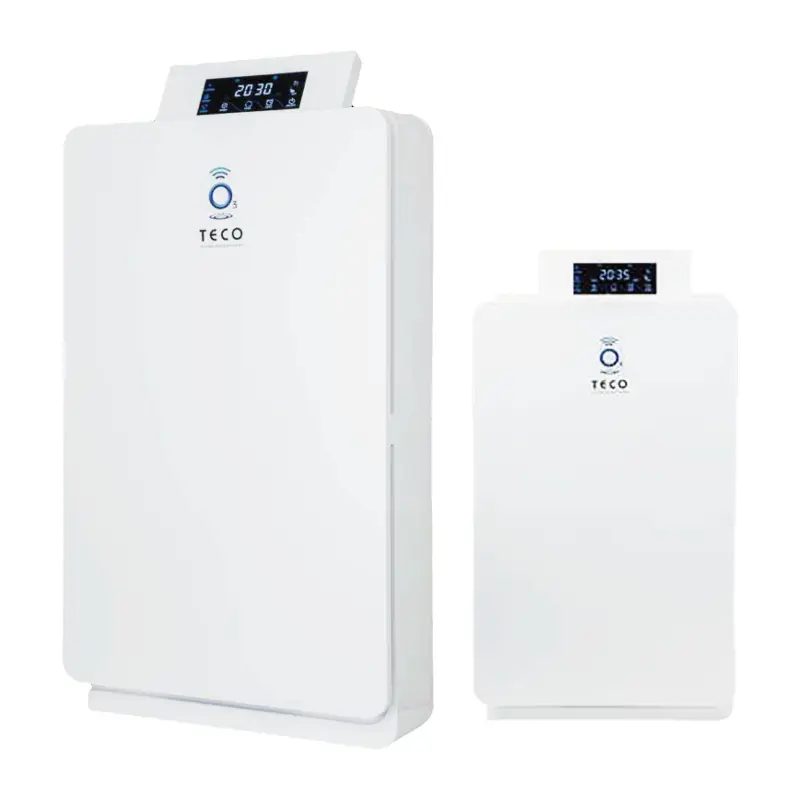
AIC Recommended / Most Popular Model
Ozone Gas Generator “BT-180H"
Equipped with a high-precision sensor, it automatically maintains the national safety standard (0.1 ppm or less) even in environments with people. It is a professional-grade standard model that realizes a 24-hour safe sterilization and deodorization environment, reducing the effort of daily replenishment and cleaning to zero.
Frequently Asked Questions (FAQ) Regarding Equipment Selection
Air purifiers are excellent at collecting “suspended dust and pollen," but they cannot fundamentally eliminate bacteria adhered to wallpaper or behind furniture, or ingrained odors. If you want to achieve reliable sterilization and deodorization of the entire space, we recommend introducing ozone, which reaches every corner as a gas.
The “initial cost" at the time of introduction tends to be cheaper for hypochlorous acid sprayers. However, because the raw material for ozone is “air," there are absolutely no costs for the continuous purchase of dedicated liquid agents after introduction, nor “labor costs (working time)" for staff to dilute and replenish the tank. When operated over a period of months to years, the cost performance of ozone is reversed.
Air purifiers can always be used safely. Ozone can also operate safely 24 hours a day as long as it is automatically controlled to “0.1 ppm or less (national safety standard)" by a high-precision sensor, like the equipment provided by AIC. On the other hand, caution is required with spatial spraying of hypochlorous acid water, etc., as there are cases where “use in environments inhaled by people is not recommended" by guidelines from the Ministry of Health, Labour and Welfare.
When spraying liquid agents such as hypochlorous acid water, caution is required regarding metal rust (corrosion) caused by moisture and salt. Ozone can also degrade rubber, etc., if used continuously at extremely high concentrations, but in a “safe, low-concentration environment (0.1 ppm or less)" automatically maintained by AIC’s equipment, there are no adverse effects even in environments with general office automation or medical equipment.
Conclusion: If You Want to Achieve Both Reliability and Reduction of Effort
While each technology has the right person for the right place, the reason ozone is standardly adopted in professional settings such as medical institutions, fire departments, and food factories boils down to its “overwhelming sterilization and deodorization power" and “the fact that it requires no daily operational labor (costs)."
To everyone who wants to turn anxiety about the air into peace of mind.
At AIC Co., Ltd., we have prepared a free introduction study guide based on our track record of 18 years. Please be sure to check the empirical data that can be used as is for approval documents, and more detailed comparison data with other companies.
Article Supervision
Since 2006, we have been pursuing ozone technology at the forefront of infection control. Based on the manufacturer’s technology whose effectiveness has been proven through joint research with Nara Medical University and Fujita Health University, we are spreading correct hygiene management backed by scientific evidence to medical and public institutions in Japan.