


How to Choose a Commercial Food Waste Disposer | 6 Essential Points to Avoid Failure – AIC
How to Choose a Commercial Food Waste Disposer | 6 Essential Points to Avoid Failure!

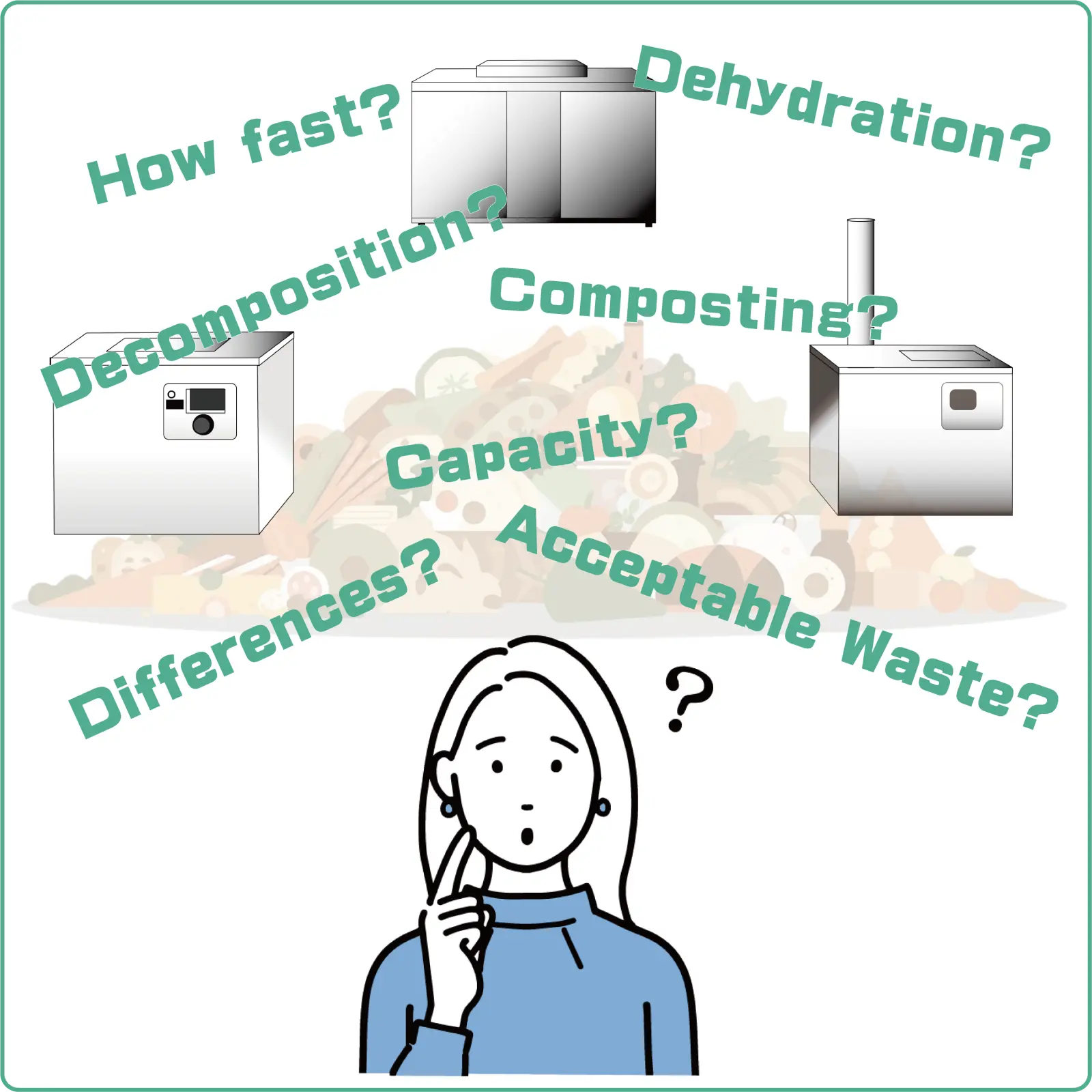
Are you struggling with what criteria to use when selecting a commercial food waste disposer?
There are various manufacturers of commercial food waste decomposition systems. Each manufacturer builds excellent products based on their unique concepts.
However, there are significant differences hidden in aspects that cannot be seen just by looking at catalog capacities or unit prices!
[Conclusion] The 6 Essential Points to Choose the Right Commercial Disposer
-
- Point 1: Understand the differences in processing methods (Decomposition, Liquefaction, etc.) and how the output is handled.
- Point 2: Check the “actual processing capacity (measured value)" and “required input frequency," not just the catalog values.
- Point 3: Confirm the “types of food waste" (sorting requirements/restrictions) that can be input into the machine.
- Point 4: Compare the “maintenance frequency and labor costs," including daily cleaning.
- Point 5: Grasp the “hidden running costs" related to the replenishment and replacement of microbes/bio-bedding.
- Point 6: Judge comprehensively based on the “7-year Total Cost of Ownership (TCO)," not just the unit price.
Here, we have picked up 6 critical points to avoid failure for those struggling to choose a commercial food waste disposer.
If you consider these 6 points, you will surely find the optimal commercial disposer for your facility.
1. Compare the Differences in Processing Methods (Decomposition, Liquefaction, Compost, Dehydration)
Commercial food waste disposers are broadly divided into 4 types.
① Decomposition Type (Bio-Method / Water-Discharge)
The Decomposition Type uses the power of microbes to break down food waste into water and carbon dioxide. The volume reduction rate is 99.9%. Processing is fully automatic and fast, and maintenance requires only simple cleaning by the user once a month*. Because this type discharges the waste as water, there is no need to worry about disposing of compost. Furthermore, among commercial disposers, it achieves near-zero residue, zero odor, low cost, and high hygiene. It is no exaggeration to say this is the mainstream commercial disposer, widely adopted in nursing facilities, nursery schools, hospitals, hotels, restaurants, government offices, and ships. The discharged water can be diluted and reused as functional water on-site (consult the manufacturer for usage details), reducing environmental impact through resource circulation. *Annual manufacturer maintenance is recommended (optional).
② Liquefaction Type (Sludge-Discharge)
The Liquefaction Type also uses the power of microbes. While broadly classified as a decomposition type, food waste is liquefied and discharged as an aqueous solution. The discharged solution can also be diluted and used as functional water. Because the main unit is very compact, it is recommended for those concerned about installation space. However, precisely because it is so compact, it cannot process a large amount of food waste at once, requiring multiple trips to input the waste, which tends to increase labor costs and the physical burden on employees. Additionally, you must be careful about the types of food waste you put in: rice can only make up to 30% of the input, and it struggles to process vegetable cores and meat. Because it generates a lot of sludge, maintenance is required every 1 to 4 months.
③ Compost Type (Bio-Method)
The Compost Type breaks down waste using microbes, but if there is a large amount of food waste, decomposition takes several weeks to months. Therefore, it is recommended for industries that actually need compost. Management is extremely difficult; if the food waste is too wet, decomposition slows down, so dry materials (paper scraps, wood chips, etc.) must be mixed in. Conversely, if it is too dry, microbe activity drops, so maintaining proper humidity is crucial. If considering this as a waste disposal method, securing a destination for the compost beforehand is an absolute prerequisite. Practically, it is often introduced as part of environmental education or local resource circulation activities rather than purely for waste reduction, and producing compost is its primary purpose.
④ Dehydration Type
Dehydration-type disposers evaporate moisture with hot air to dry the waste and reduce its volume. (There are also “food waste dryers" which are machines dedicated solely to air drying.) The purpose of a dehydration disposer is not to decompose and eliminate the waste, but to reduce its volume. Because it is not a complete eradication, the dried waste (crispy residue) must still be disposed of. Dehydration-type disposers require massive amounts of energy to dry the moisture. As a result, utility costs (electricity, gas, kerosene) tend to skyrocket. They produce noise comparable to an air purifier, so caution is needed in areas requiring quietness. Regarding odors, while they have deodorizing filters, users often report that odors emerge after long-term use. To use the dried waste directly as fertilizer, it must undergo further composting treatment. Note that operating a dehydration disposer may require the appointment of a certified hazardous materials handler depending on local regulations.
① Decomposition Type (Mainstream / High Hygiene)
Breaks down food waste into “water and carbon dioxide" using microbes. The most popular commercial type today.
- Overwhelming Reduction Rate: Approx. 99.9%. Waste almost disappears.
- Excellent Hygiene: Odors and residues are virtually zero.
- Cost Reduction: Fully automatic processing cuts labor and disposal fees.
- Easy Management: Operational with simple monthly cleaning.
*Widely adopted in nursing homes, hospitals, and hotels.
② Liquefaction Type (Space-Saving)
Liquefies food waste and discharges it as an aqueous solution.
- Merit: Extremely compact and can be installed anywhere.
- Caution: Cannot handle large batches at once; requires frequent small inputs.
- Restrictions: Rice up to 30%. Unsuitable for hard vegetable cores or meat.
- Maintenance: Sludge accumulates, requiring mandatory inspection every few months.
③ Compost Type (Resource Circulation)
Uses microbes to break down waste and produce fertilizer (compost).
- Purpose: Ideal for environmental education or local circulation activities.
- Management: Requires advanced knowledge like moisture and humidity control.
- Speed: Takes weeks to months to complete composting.
- Challenge: Securing a stable “destination" for the generated compost is essential.
④ Dehydration Type (Volume Reduction)
Evaporates moisture with hot air to reduce the volume of food waste.
- Mechanism: Does not decompose; the remaining dried waste must be disposed of.
- Running Cost: Utility bills tend to be high due to the heat source.
- Environment: Risks of operational noise and odor leakage over long-term use.
Comparison Table of 4 Commercial Disposer Types
| Item | Decomposition | Liquefaction | Compost | Dehydration |
|---|---|---|---|---|
| Processing Method | Completely breaks down into water and CO2 via microbes. | Breaks down into aqueous solution via microbes + agitation + watering. | Produces compost via microbial decomposition. | Evaporates moisture with hot air. Only reduces volume. |
| Processing Time | Few hours to half a day | Approx. 5-24 hours (depending on waste type) | Few days to approx. 1 week | Few hours |
| Odor Generation | Virtually odorless (Structure leaves no odor source) | Virtually odorless | Prone to fermentation odors | Relatively low |
| Post-Processing Usage | Discharged as water and CO2, virtually zero residue. (99.9% volume reduction) |
Drainable as aqueous solution, virtually zero residue. | Reusable as compost. | Disposed of as dried waste or composted. *Requires 1-4 weeks of maturation mixed with soil if used as fertilizer. |
| Energy Costs | Water bills apply (Varies by model) |
Water bills apply (Varies by model) |
Basically unnecessary (Manual type) |
Expensive due to heating |
| Maintenance | No special maintenance, just basic water washing | Requires short-cycle replenishment of microbes; high sludge requires regular removal | Microbe management, bedding replenishment | Minor, such as filter cleaning |
| Installation Location | Both indoor & outdoor. High hygiene, proven in nursery schools, etc. | Indoor installation possible, compact design | Outdoor recommended (Odor control) | Indoor installation possible (Quiet design) |
As you can see, the term “Commercial Food Waste Disposer" covers a wide variety of methods.
2. Beware of Differences Between “Catalog Values" and “Actual Processing Capacity"
The reality is that there are no clear, unified standards for expressing the processing capacity of commercial food waste disposers. Each manufacturer lists the processing capacity in their catalog based on their own unique logic.
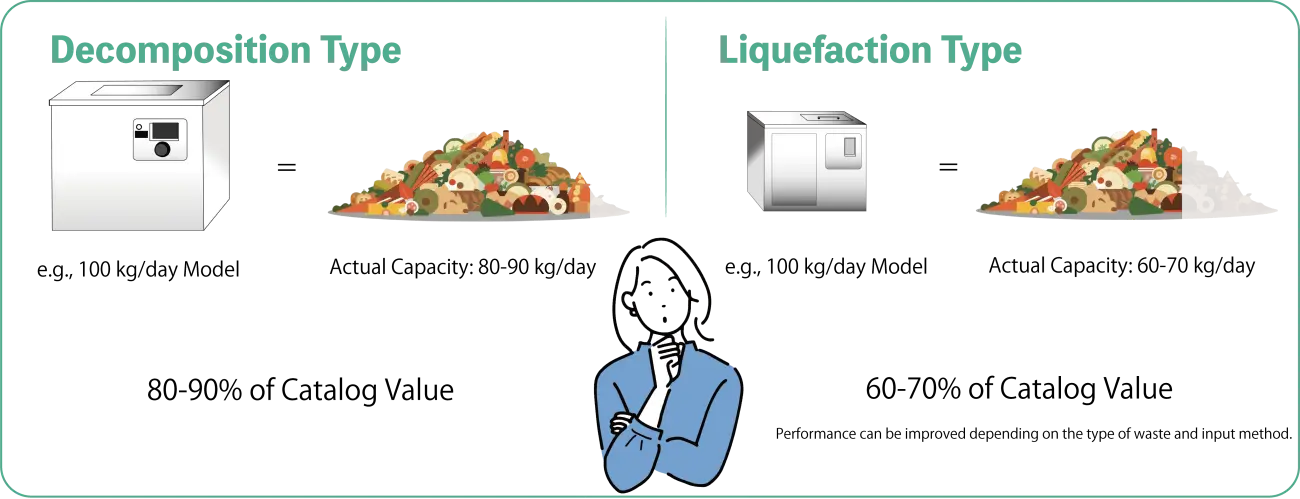
For example, even among disposers that claim to process 100kg a day, Decomposition types typically deliver 80% to 90% of their catalog value, whereas many Liquefaction types can only process about 60% to 70% of their catalog value. You must be careful because the actual amount that can be processed varies.
[Comparison of Catalog Capacity vs. Actual Capacity]
| Decomposition Type | Liquefaction Type (Brand A) | Liquefaction Type (Brand B) | |
|---|---|---|---|
| Catalog Processing Capacity | 100 kg/day model | 100 kg/day model | 100 kg/day model |
| Actual Processing Capacity | 80 ~ 90 kg/day | 60 ~ 70 kg/day | 60 ~ 70 kg/day |
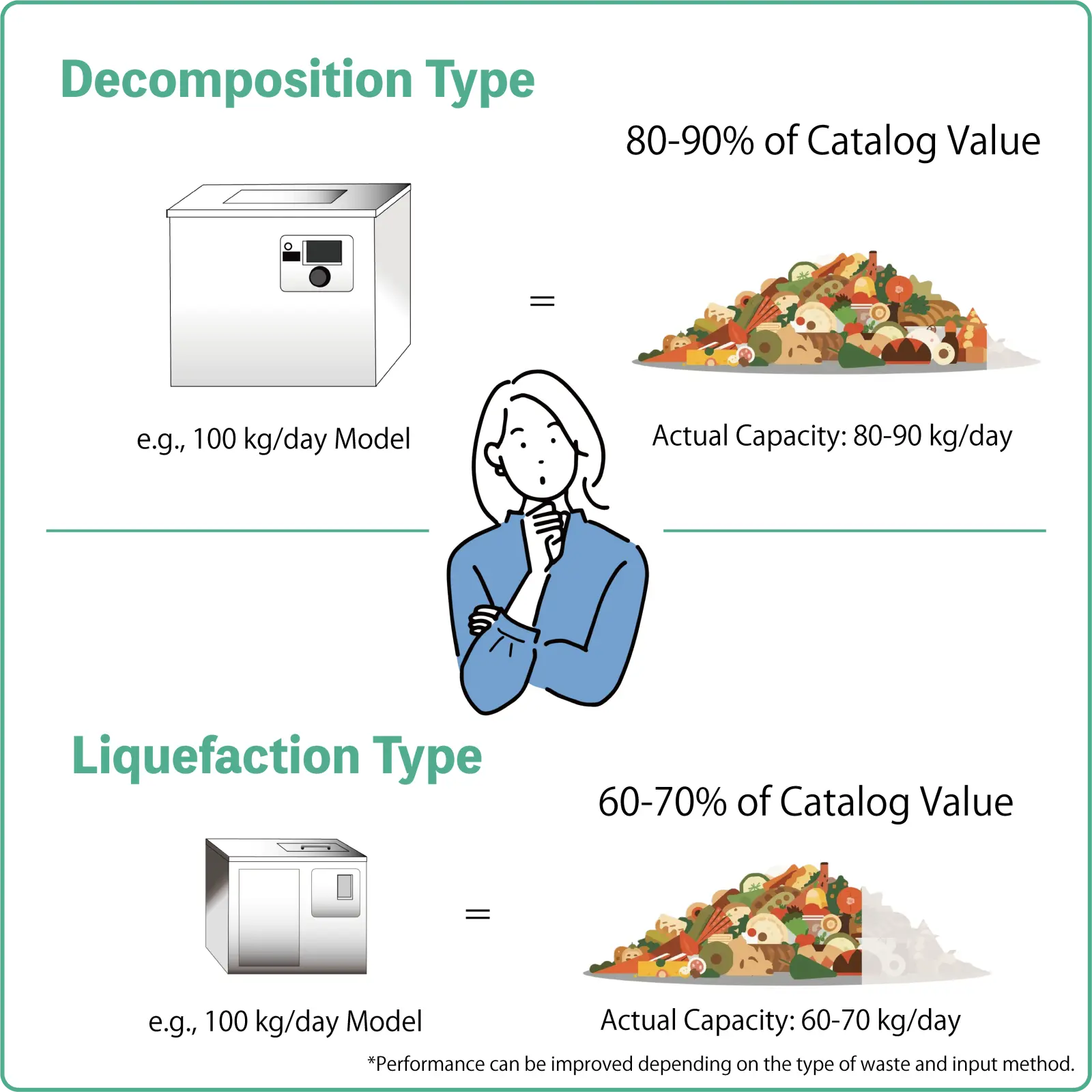
This is similar to automobiles: the manufacturer’s advertised fuel efficiency in the catalog often does not match the actual mileage you get on the road.
Therefore, to process the actual amount of food waste your facility generates, you must be aware that for some machines, you need to select a model much larger than the catalog value suggests.
[Labor Costs Due to Differences in Input Frequency]
The processing volume of a commercial disposer is defined by each manufacturer, but even if they claim the same volume, the required “frequency of waste input" may differ.
Naturally, the more frequently you have to input waste, the more “labor costs" increase on-site, so caution is required.
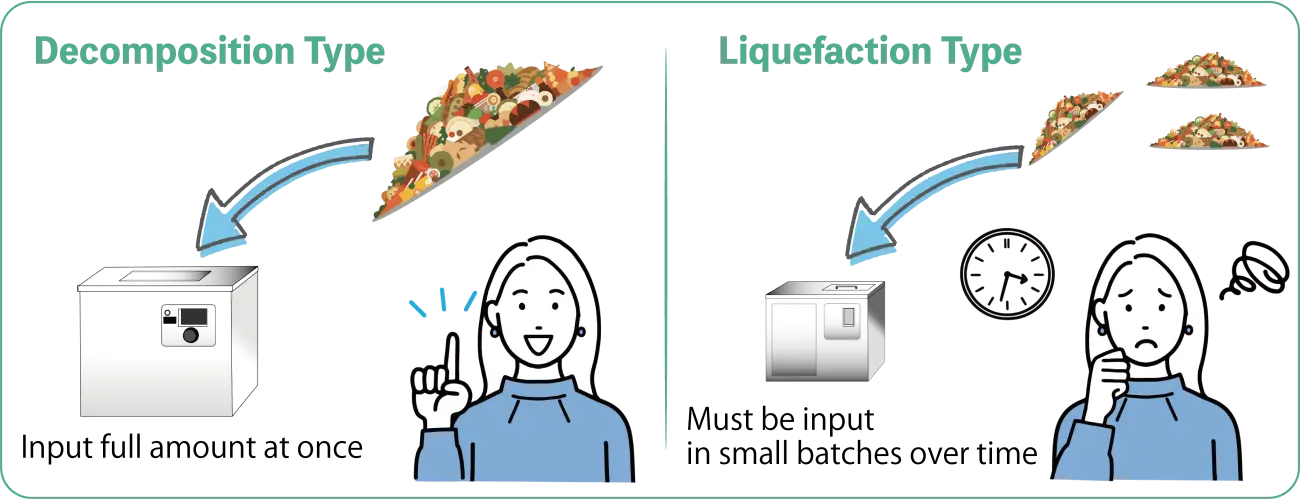
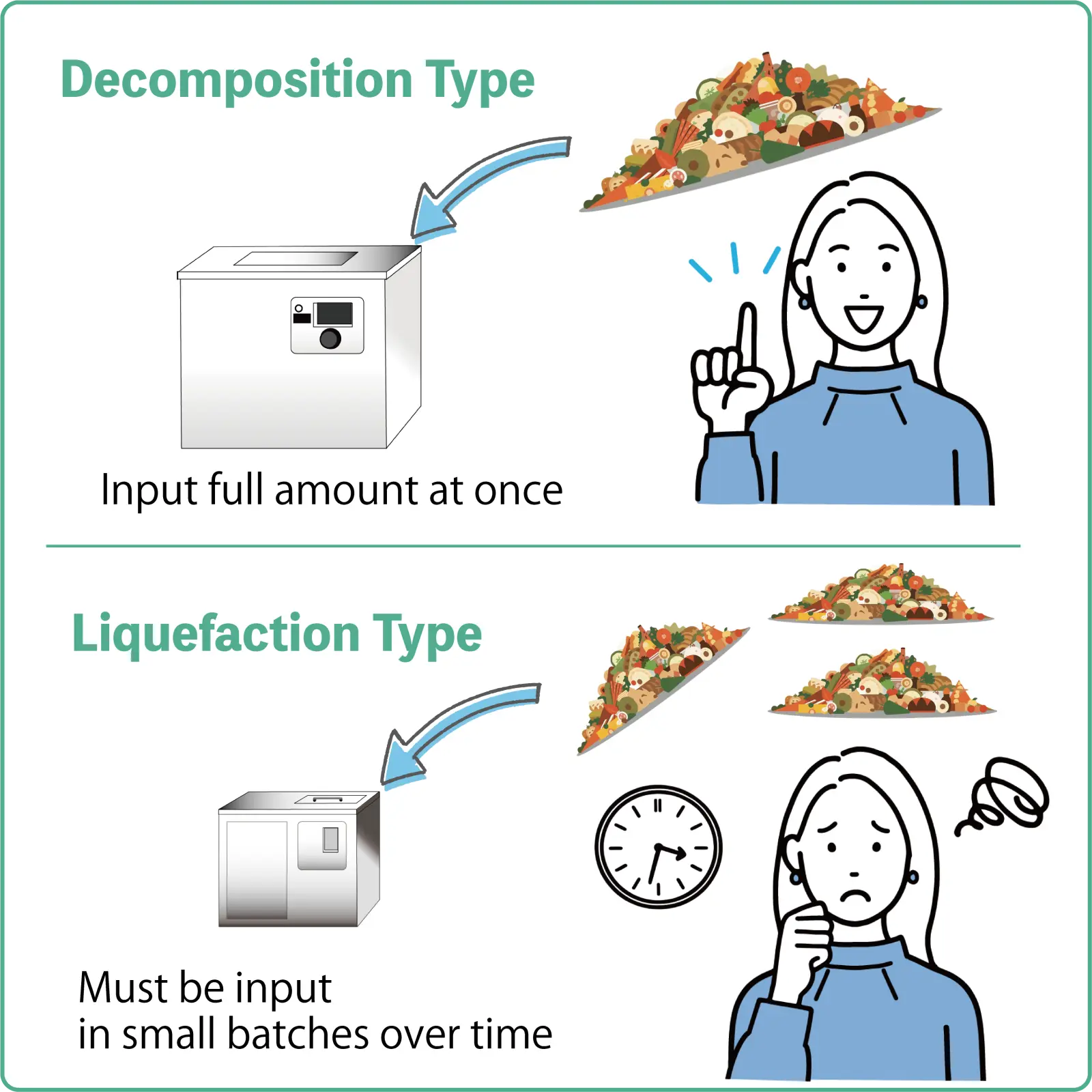
A. Compact models (Liquefaction type) lack the internal volume and space to hold a lot of waste at once, inevitably requiring multiple trips to input the waste.
*Continuous input is technically possible for both Decomposition and Liquefaction types, but volume limits apply.
3. Confirm the “Types of Food Waste" (Sorting Requirements & Restrictions)
Depending on the type of commercial disposer, you may have to be very careful about sorting the food waste you put in.
Due to differences in their mechanisms, commercial disposers often impose restrictions on the types and proportions of food waste that can be input.
Also, it is crucial to remember that the difference in processing methods greatly affects “odor generation."
Even among “commercial disposers," the processing method varies by manufacturer.
The Decomposition Type (complete microbial breakdown) leaves the least residue and is the least prone to generating foul odors.
[Differences in Acceptable Food Waste Types and Processing Methods]
| Comparison Item | Decomposition Type | Liquefaction Type (Brand A) | Liquefaction Type (Brand B) |
|---|---|---|---|
| Rice & Carbs | No restrictions | Up to 30% only | Up to 30% only |
| Meat & Hard Veggie Cores | No restrictions | Often cannot be processed | Often cannot be processed |
| Processing Method | Microbial Decomposition (Water & CO2: 99.9% reduction) |
Microbial Decomposition (Liquefaction: Aqueous Solution) |
Microbial Decomposition (Liquefaction: Aqueous Solution) |
| Odor | ○ (Good) | △ (Fair) | △ (Fair) |
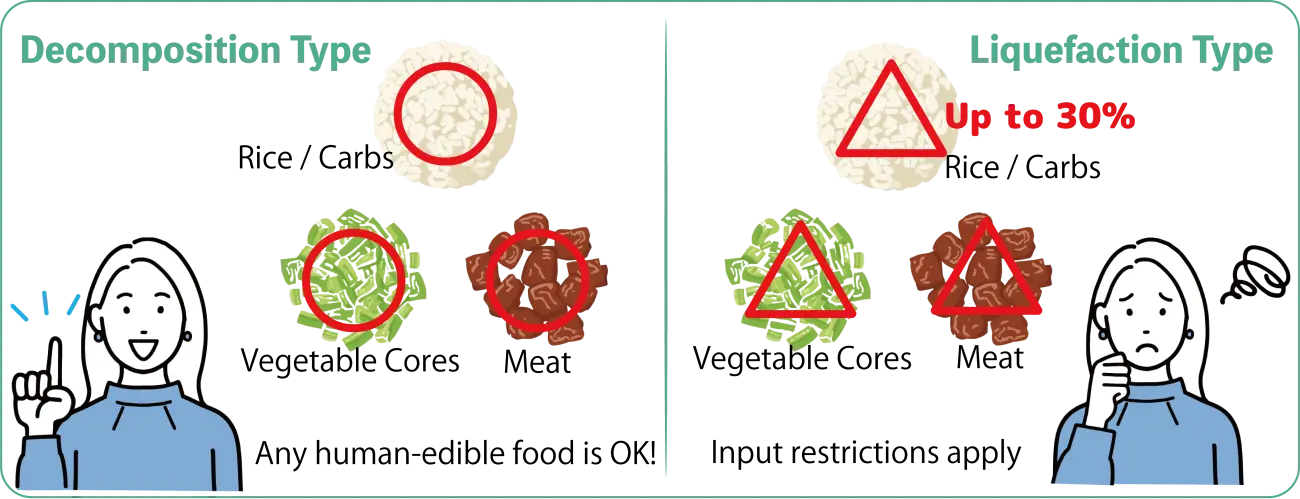
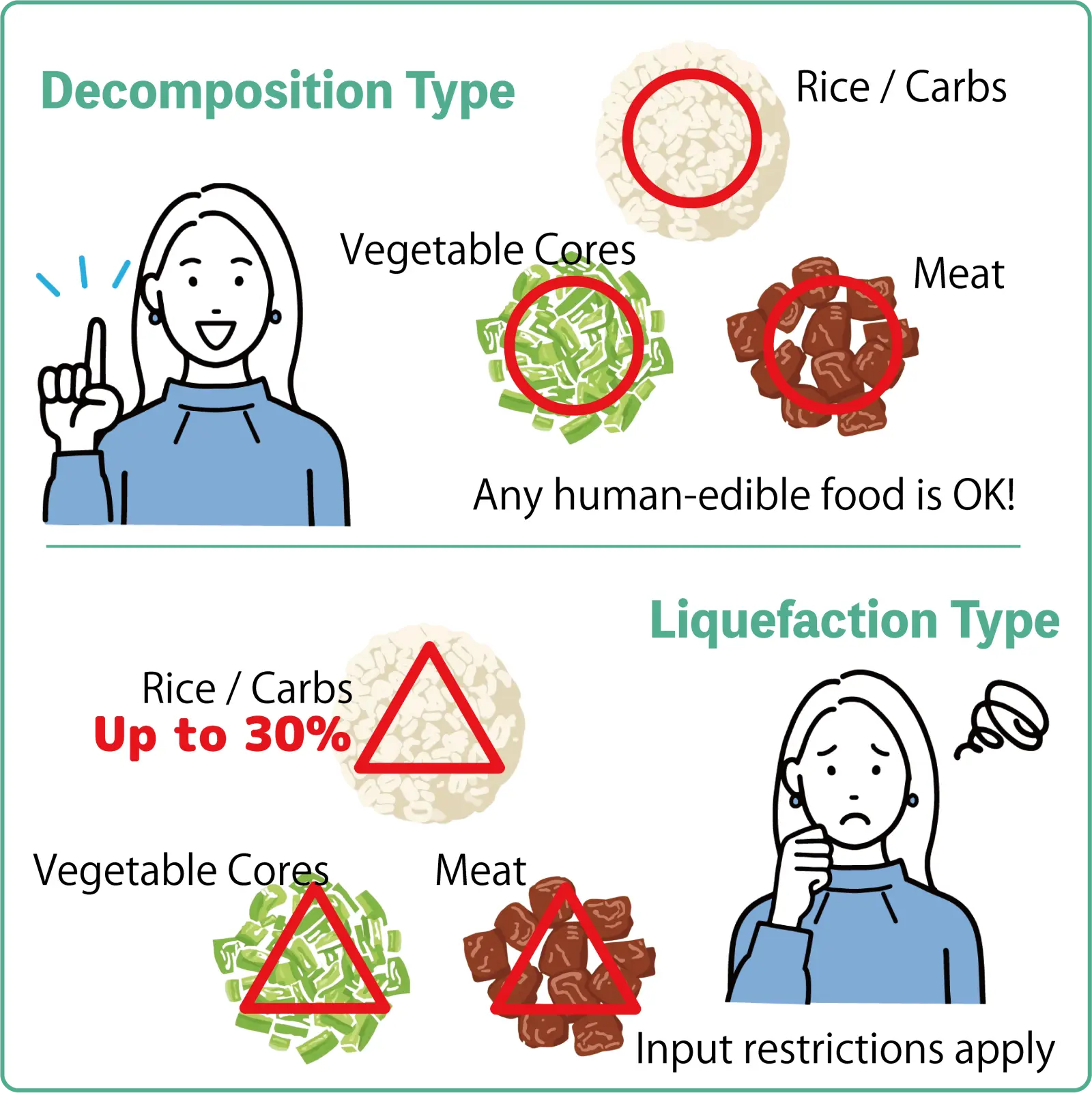
If such restrictions exist, you will need to “sort the food waste" before inputting it, forcing you to spend additional “labor costs" separate from your core duties.
In an era of labor shortages and work-style reforms, you want to choose a commercial disposer that minimizes labor costs as much as possible.
4. Compare Maintenance Frequency and Labor Costs (Effort)
Depending on the type of commercial disposer, if you do not clean and maintain it frequently, the drainage pipes can clog, or the septic tank can overflow.
[Differences in Maintenance Requirements]
| Comparison Item | Decomposition Type | Liquefaction Type (Brand A) | Liquefaction Type (Brand B) |
|---|---|---|---|
| Machine Maintenance by Manufacturer | Optional
Because sludge is minimal, simple cleaning by the customer and bio-bedding replenishment is sufficient. (Annual manufacturer maintenance recommended) |
Mandatory (Every 3-4 months)
Due to high sludge, pipes will clog if not washed monthly. Risk of septic tank overflow. Requires bio-bedding disposal/replacement and microbe replenishment. |
Mandatory (Once a month)
Due to high sludge, pipes will clog if not washed monthly. Risk of septic tank overflow. Requires bio-bedding disposal/replacement and microbe replenishment. |
| Effluent SS & BOD Levels | Low (Excellent) | High (Poor) | High (Poor) |
| Parts Replacement & Lifespan | 10-Year Durability; No replacement needed until failure.
*Track record of units operating for over 26 years. |
Various parts must be replaced every 2 years in principle.
*Lifespan is unknown as sales history is under 10 years. |
10-Year Durability; No replacement needed until failure.
*Lifespan is unknown as sales history is under 10 years. |
As shown here, you must pay attention to the labor and parts replacement costs required for daily maintenance, which cannot be seen just by looking at the catalog.
Q. What are the “Effluent SS and BOD Levels" I often hear about?
A. SS and BOD are crucial indicators for evaluating the degree of water pollution.
- ■ SS (Suspended Solids)Indicates the amount of solid matter (visible mud, fine organic matter, etc.) suspended in water.
What if it’s high? The water becomes cloudy, potentially harming aquatic life and clogging plumbing systems. - ■ BOD (Biochemical Oxygen Demand)Indicates the “amount of oxygen" required by microbes to break down organic matter in the water. It measures how “dirty" the water is.
What if it’s high? Oxygen in the water gets depleted, causing environmental damage such as aquatic organisms being unable to survive.
5. Grasp “Hidden Running Costs" such as Microbe Replenishment Fees
The mechanism by which Decomposition-type commercial disposers process food waste lies in “microbes (bacteria)."
Microbes are, of course, living organisms.
To ensure the microbes comfortably process the food waste, they require a pleasant living environment.
In other words, the “Bio-Bedding" where the microbes firmly “settle" and work is crucial.
If the microbe settlement is poor, you will frequently need to replenish them.
Caution is required because the running costs will vary significantly depending on the quality gap of this “Bio-Bedding."
[Comparison of Bio-Bedding / Microbe Maintenance Costs]
| Comparison Item | Decomposition Type | Liquefaction Type (Brand A) | Liquefaction Type (Brand B) |
|---|---|---|---|
| Bio-Bedding / Microbes | Bedding: Natural Materials (Rice husks, straw, wood chips, etc.) Microbes: Common soil bacteria |
Bedding: Artificial Materials (Polypropylene, plastic resin) Microbes: Proprietary specific bacteria |
Bedding: Artificial Materials (Polypropylene resin, ceramic balls) Microbes: Proprietary specific bacteria |
| Microbe & Bedding Maintenance | Replenish only the depleted amount of bedding a few times a year. Since the bedding comes with microbes attached, only the bedding needs replenishing (No total replacement/removal). | Replenish several types of proprietary microbes every 4 months.
Total replacement and removal of bedding is required (Every 2 years). |
Replenish microbes and bedding every month.
Total replacement and removal of bedding is required. |
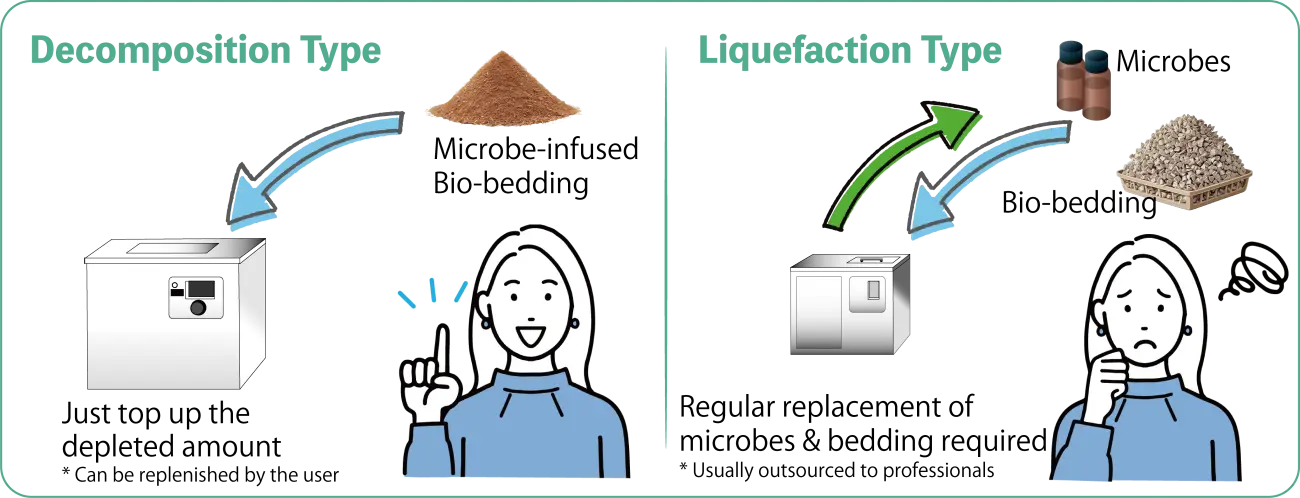
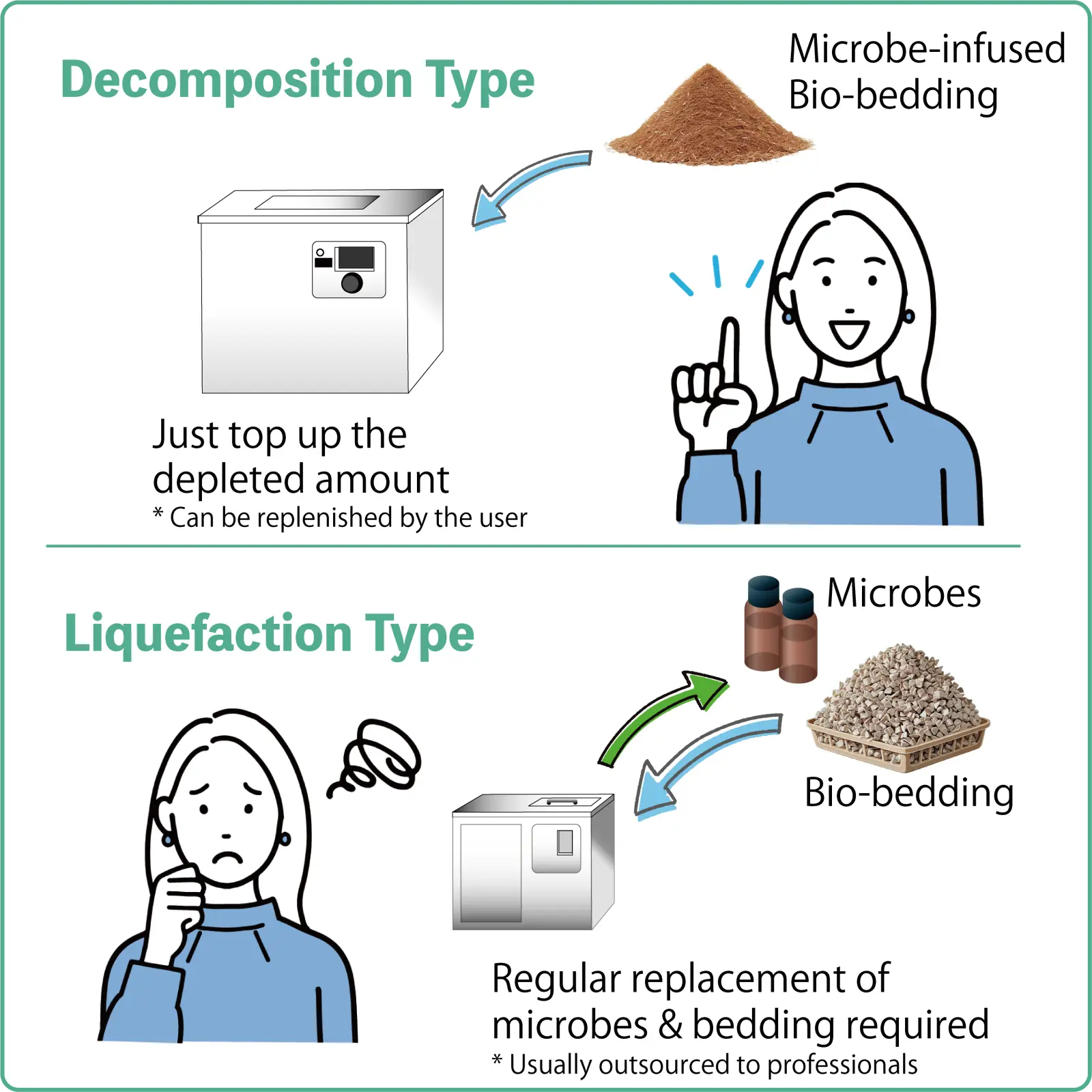
Please be aware that some machines require expensive fees and massive labor for regular replacements just to keep the microbes working.
A. In the case of “artificial bedding" like plastics, when they wear down, the microbes lose their home, resulting in a drop in decomposition power. Worn-out artificial materials cannot be replaced unless they are entirely scooped out. On the other hand, “natural material bedding" simply decomposes gradually and disappears, so you only need to top it up. Because there is always a fresh home available, the microbes can continue working vigorously.
6. Compare Not Just the Unit Price, but the “7-Year Total Cost"
As you have seen so far, due to differences in processing capacity, acceptable inputs, and maintenance frequency/costs, there can be a massive cost difference in running and labor costs after installation depending on the commercial disposer you choose.
[Total Cost Estimate Example]
*Comparison based on a 100 kg/day model over a 7-year lifespan.
| Comparison Item | Decomposition Type | Liquefaction Type (Brand A) | Liquefaction Type (Brand B) |
|---|---|---|---|
| Unit Price | Standard Market Price | Slightly Lower Price | Standard Market Price |
| Maintenance & Microbe Fees (7 Years) | Extremely Low (Minor top-ups + optional maintenance) |
High (Mandatory contracts, frequent bed replacements) |
Very High (Mandatory contracts, frequent bed replacements) |
| Parts Replacement Costs | None | Parts replaced approx. 3 times (Every 2 years: Extra actual cost) |
None |
| Total 7-Year Cost | The Most Cost-Effective | Higher than Decomposition Type (+ Extra Parts Costs) |
Massively More Expensive |
As you can see, when “maintenance fees" are included, there is a massive gap in the total amount paid. Furthermore, you must not forget the significant differences in daily “labor costs" caused by having to sort waste or make frequent trips to input small batches.
Summary of Essential Points for Choosing
a Commercial Food Waste Disposer
What did you think? We hope you now understand that under the umbrella term “Commercial Food Waste Disposer," there are realities regarding processing methods, maintainability, and total costs that cannot be seen just by looking at catalog numbers.
To help you choose the best machine for your company,
we have summarized the 6 essential selection points once again.
- POINT 1
Make your selection after carefully considering your waste volume and how the processed output will be handled! - POINT 2
Always confirm the “Actual Processing Capacity" and “Input Frequency" with each manufacturer! - POINT 3
Confirm whether there are “restrictions on the types of food waste" that can be input! - POINT 4
Choose a machine with low labor burden (labor costs) and low maintenance frequency! - POINT 5
Confirm the “frequency of replenishment and replacement of microbes and bio-bedding"! - POINT 6
Think in terms of Total Cost (Unit Price + Running Costs + Labor Costs)!
Summary Comparison: Decomposition Type vs. Liquefaction Type
| Comparison Item | Decomposition Type | Liquefaction Type (Brand A) | Liquefaction Type (Brand B) |
|---|---|---|---|
| Actual Processing Capacity | ◎ Good Can process 80-90% of catalog value |
△ Fair Only 60-70% processing capacity |
△ Fair Only 60-70% processing capacity |
| Acceptable Input Types | ◎ Excellent No restrictions as long as it’s edible by humans |
△ Fair Rice up to 30%; struggles with meat/veggie cores |
△ Fair Rice up to 30%; struggles with meat/veggie cores |
| Post-Processing Output | ◎ Excellent Water and Carbon Dioxide |
○ Good Aqueous Solution |
○ Good Aqueous Solution |
| Machine Maintenance | ◎ Excellent Optional (Annual manufacturer maintenance recommended) |
△ Fair Mandatory (Every 3-4 months) |
△ Fair Mandatory (Once a month) |
| Microbe/Bedding Maint. | ○ Good Top up only the depleted amount (User can do it: few times a year). No replacement/removal needed. |
△ Fair Replenish specific microbes every 4 months. Bedding replacement/removal required (Every 2 years). |
△ Fair Replenish microbes and bedding monthly. Bedding replacement/removal required. |
| SS & BOD Levels | ◎ Excellent Low |
△ Fair High |
△ Fair High |
| Parts Replacement / Lifespan | ◎ Excellent 10-year durability, no replacement until failure. *Track record of units operating over 26 years. |
△ Fair Various parts must be replaced every 2 years in principle. *Lifespan unknown (sales history under 10 years). |
○ Good 10-year durability, no replacement until failure. *Lifespan unknown (sales history under 10 years). |
| Unit Size | ○ Good Small |
◎ Excellent Even more compact |
◎ Excellent Even more compact |
| Total Cost | ○ Good The Most Cost-Effective |
△ Fair Higher than Decomposition Type (+ Extra Parts Costs) |
△ Fair Massively More Expensive |
Conclusion: The Decomposition-Type Disposer “GOMISER" is the Optimal Choice
32 years of history and a track record of 2,600 units sold.
The GOMISER, the pioneer of decomposition types, meets all these strict selection criteria at a high level.
Our professionals will diagnose and propose the optimal plan for your site free of charge.
The Pioneer of Decomposition-Type Commercial Disposers: “GOMISER"
32 years of history and a solid sales record of over 2,600 units.
The No.1 proven “GOMISER" meets all these strict selection criteria at a high level.
Professionals with 32 years of expertise will diagnose and advise you on the optimal plan for your site, free of charge.
Watch the “GOMISER" Eradication Mechanism
We explain the mechanism that decomposes and eliminates 99.9% of food waste using the power of bacteria.

[Summary] How to Choose a Disposer Without Failing
If you choose based solely on catalog numbers or initial costs, you will likely face troubles after installation such as “it can’t process enough" or “maintenance costs are too high." Always check the following points when selecting a model.
- 📊 Compare by “actual daily processing capacity (during normal operation)," not maximum volume.
- 💸 Calculate “hidden running costs" like utility bills, bio-bedding replacement, and residue (compost) disposal fees.
- ✨ Base your consideration on the “Decomposition Type (GOMISER)," which has the lowest operational burden and maintenance cost.
Consultations, Free Quotes, and Information Requests
We Support Environmental Improvement & Cost Reduction
with Professional Technology via “GOMISER"
We Support Environmental Improvement & Cost Reduction
with Professional Technology via “GOMISER"
Dedicated staff with 32 years of experience will carefully propose the optimal plan tailored to your facility’s specific needs.