
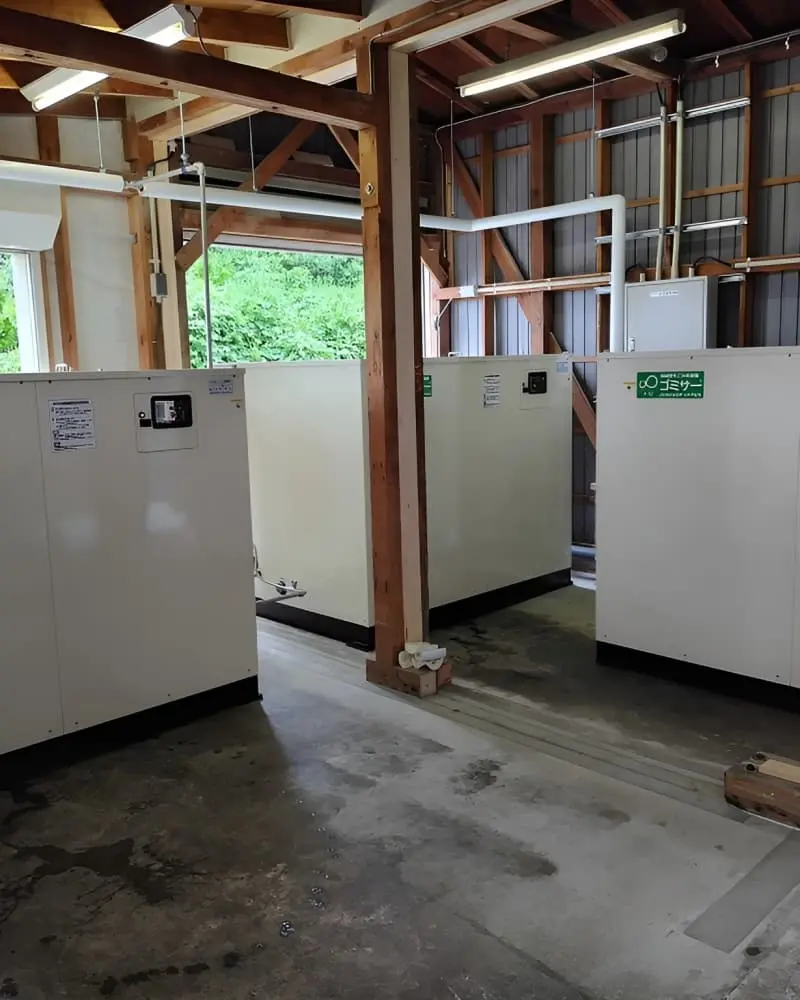


[Official Statement] The Decisive Difference Between Ozone Treatment and Aeration in Grease Traps | Scientific Evidence
AIC OFFICIAL TECHNICAL REPORT
[Official Statement] The Decisive Difference Between “Aeration" and “Ozonolysis" (Chemical Decomposition) in Grease Trap Purification
In this report, we officially clarify, backed by global scientific evidence, that the ozone treatment technology utilized in the “AIC Grease Ozonizer" is fundamentally different from simple aeration. It is an “irreversible chemical reaction (ozonolysis)" and a highly effective environmental preservation technology that actively prevents water pollution.
1. The Difference Between Physical Processes (Emulsification) and Chemical Reactions (Ozonolysis)
While “pumping air" (aeration) and “pumping ozone" (ozone treatment) may look similar to the naked eye, the phenomena occurring within the water are on entirely different dimensions.
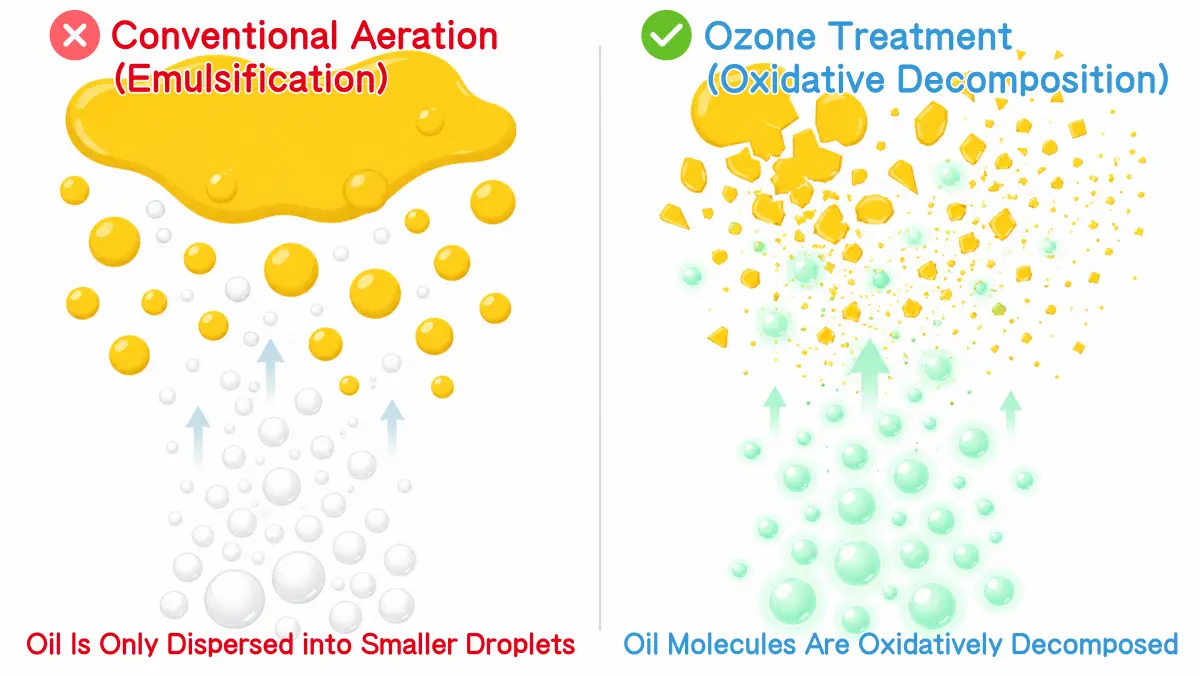
❌ Aeration (Physical Process)
This process merely agitates and disperses water and oil into fine droplets (emulsification). The molecular structure of the oil remains completely unchanged. Even if it appears clean temporarily, once it flows into the municipal sewer and the water temperature drops, it will inevitably separate and solidify again, causing severe pipe blockages and secondary water pollution. What authorities prohibit and strictly regulate is the “discharge of this untreated emulsified FOG (Fats, Oils, and Grease)."
✅ Ozone Treatment (Chemical Reaction)
Through the powerful oxidizing capability of ozone, the molecular structure of the oil (carbon double bonds) is chemically cleaved and decomposed. Giant oil molecules are structurally transformed into completely different, highly water-soluble low-molecular-weight compounds. Because this chemical change is irreversible, the substances can never solidify again, completely eliminating the risk of pipe blockages.
2. Scientific Evidence: Cleavage of Molecular Chains via the Criegee Mechanism
The claim that “oil is transformed into a different substance" is not a mere sales pitch. It is based on an absolute chemical reaction established in international academic journals known as “Ozonolysis."
Oxidative Cleavage of Double Bonds by Ozone (Criegee Mechanism)

Unsaturated fatty acids, the primary components of animal and vegetable fats, contain “double bonds (C=C)" where carbon atoms are tightly linked. When ozone (O3) comes into contact with these double bonds, it interrupts the bond and completely severs the molecular chain. This process, known as the “Criegee mechanism," structurally modifies massive, sticky FOG molecules into fine, water-soluble molecules such as aldehydes and carboxylic acids.
Conclusion: Ozone treatment is not “discharging oil as it is into the sewer," but rather an advanced purification process that “chemically decomposes oil into harmless water-soluble substances before discharge."
3. Analytical Chemical Proof and Contribution to “Water Quality Improvement"
The disappearance of FOG in water through ozone treatment has been proven by global research using state-of-the-art precision analytical instruments like GC-MS (Gas Chromatography-Mass Spectrometry). Scientific data confirms that the peaks of the original long-chain fatty acids (oil) disappear, while short-chain organic acids (water-soluble) are generated.
Why Does Ozone Treatment Contribute to “Water Conservation"? (Enhancement of Biodegradability)
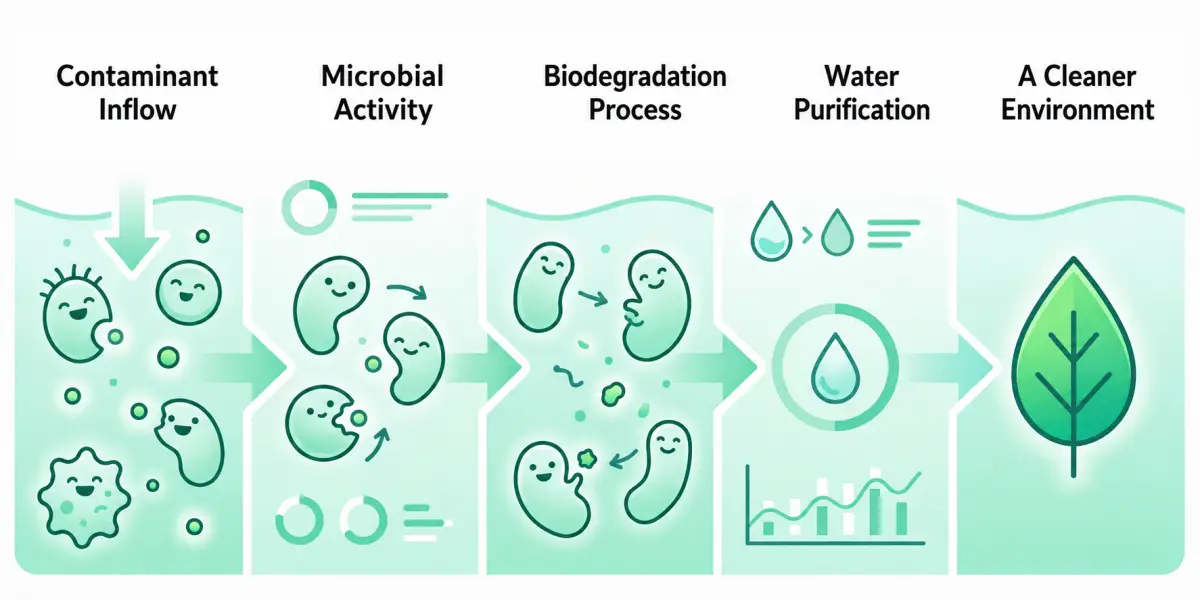
In sewage treatment plants, wastewater is purified through the action of microorganisms. However, giant, untreated oil molecules are “too large to digest" (recalcitrant) for these microorganisms, placing a massive burden on the treatment facility and ultimately causing water pollution.
Conversely, the organic acids finely cleaved by ozone become highly accessible and easily digestible food for natural microorganisms (high biodegradability). In other words, applying ozone treatment inside a grease trap directly assists the microorganisms in sewage treatment plants, making it an exceptionally superior environmental measure that accelerates the purification of rivers and oceans.
Because ozone itself quickly reverts to harmless oxygen (O2) after the reaction, there is zero risk of secondary pollution or residual toxicity associated with harsh chemicals.
4. Comparison: Conventional Aeration vs. Ozone Treatment
We have summarized the differences in technical mechanisms and their resulting impacts on water quality in a clear table below.
| Criteria | Conventional Aeration (Air Sparging Only) |
Ozone Treatment (Ozonolysis Reaction) |
|---|---|---|
| Treatment Mechanism | Mere agitation & dispersion (Emulsification only) |
Cleavage & Solubilization of oil molecules (Irreversible oxidative decomposition) |
| State of FOG After Discharge | Separates and solidifies again as water temperature drops |
Properties are altered; will never solidify again |
| Risk of Pipe Blockages | Significantly increases (Secondary hazard) | Drastically eliminated |
| Impact on Water Quality / Environment | Untreated oil escapes, causing severe environmental load |
Enhances biodegradability, aiding sewage treatment & conservation |
5. Official and Academic Evidence Supporting This Statement
The facts stated in this report are clearly proven by the following authoritative academic papers and the standard technologies of public institutions. Please utilize these as reference materials for compliance discussions with local authorities or for internal approvals.
Chemical Basis: Criegee Mechanism
- ● Historical proof by the mechanism’s discoverer
An academic paper (published in Angewandte Chemie) by R. Criegee himself, explaining the reaction mechanism by which ozone irreversibly cleaves the carbon double bonds of fats and oils.
Analytical Proof (GC-MS)
- ● Precision data showing the disappearance of oil
A paper in an international ozone journal proving via GC-MS that fatty acids (oil content) in water disappear through ozone treatment, chemically transforming into short-chain organic acids.
Public Infrastructure Implementation
- ● Advanced Water Treatment Technology
The technology of using ozone to reduce the molecular weight of organic matter in water, making it easier for microorganisms to decompose, is a standard adoption in water purification plants nationwide, including the Tokyo Metropolitan Waterworks Bureau.
Frequently Asked Questions Regarding Ozone Treatment, Compliance, and Water Purification
Official Statement from AIC (Conclusion)
The ozone treatment technology provided by AIC Corporation through the “AIC Grease Ozonizer" is a highly advanced “chemical decomposition and water purification process" that stands in stark contrast to the “physical aeration (emulsification)" prohibited by municipalities.
We strictly refuse to sell products lacking scientific evidence. We declare with absolute confidence and responsibility that this technology not only eliminates foul odors and cleaning burdens in food service and kitchen facilities but also significantly contributes to a sustainable society (SDGs) and global water conservation.
Official Statement by AIC
This report is published by AIC Corporation—a pioneer pursuing ozone technology at the forefront of infection control and environmental hygiene since 2006—to share the scientific truth about grease trap purification systems with society and to promote sustainable water conservation.