


Remote Island BCP Guide: In-House Food Waste Processing | GOMISER
For Medical & Care Facilities on Remote Islands
In-House Food Waste Processing & BCP Guide:
How to Eliminate Soaring Disposal Costs and Infection Risks
For hospitals and nursing homes located on remote islands or isolated areas surrounded by the sea, “waste management" poses a far more severe challenge than for mainland facilities. The exorbitant cost of maritime transport to the mainland, the halt of garbage collection due to typhoons/hurricanes or canceled ferries, and the rapid decomposition, foul odors, and infection risks brought on by warm climates…
These are not merely cost issues; they are critical risks that must be resolved urgently from the perspective of maintaining the facility’s sanitary environment during disasters (Business Continuity Planning – BCP). In this guide, we thoroughly explain the importance of “in-house, self-contained processing" that safely eradicates food waste on-site without relying on external collection infrastructure, as well as the absolute conditions for choosing a disposer that remote islands cannot afford to overlook.
The Top 3 Waste Management Risks Facing Remote Medical & Care Frontlines
1. Abnormally Soaring Industrial Waste Costs (Maritime Transport to the Mainland)
On many remote islands without their own final disposal sites, waste must be transported by ferry to the mainland. Directly affected by recent soaring fuel costs and a shortage of transport drivers, the industrial waste cost of “just throwing away garbage" has ballooned to several times that of the mainland, heavily pressuring facility management.
2. Halt of Garbage Collection Due to Typhoons & Canceled Ferries (A Fatal Flaw in BCP)
When ferries are canceled for several days due to approaching typhoons or rough seas, garbage collection by external contractors comes to a complete halt. For medical and nursing care facilities that care for patients and residents with low immunity, having massive amounts of continuously generated food waste accumulating on the premises means falling into an extremely dangerous state regarding BCP (Business Continuity Planning).
3. Rapid Decomposition, Foul Odors, and Infection Risks in Warm Climates
During periods when garbage is not collected, food waste rots mercilessly. Especially in warm island regions, it emits an intense foul odor within days, breeding massive swarms of pests like flies, maggots, and cockroaches. This not only deteriorates the working environment but can trigger critical nosocomial (in-facility) infections.
Why a “Self-Contained Extinction Disposer" is Essential for Remote Island BCP
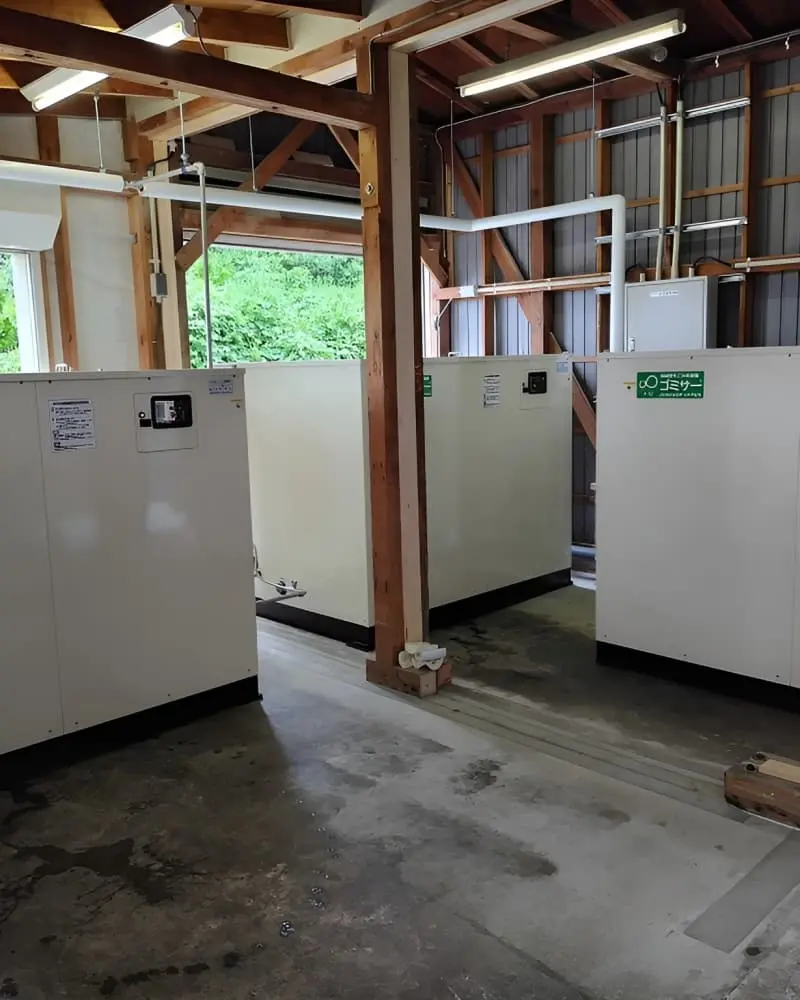
The only way to eradicate these risks is “in-house, self-contained processing of food waste on the premises" without relying on external collection infrastructure. Among these, “Extinction-type commercial food waste disposers (GOMISER)," which leave zero residue, are overwhelmingly supported by facilities on remote islands.
[Reason 1] Decomposes into Water On-Site, Independent of External Infrastructure
Extinction-type disposers use the power of microorganisms to decompose 99.9% of food waste into “water and carbon dioxide." Because waste is loaded and eradicated immediately after it is generated, food waste will never again accumulate or rot within the facility, regardless of how many days ferries are canceled. You can maintain a perfectly hygienic environment independently.
[Reason 2] Handles the “Massive Amounts of Rice/Porridge" Unique to Hospital Meals
The massive amounts of “rice and porridge (starches)" generated by medical and care facilities often cause decomposition failures in other companies’ machines (like liquid-decomposition types), frequently leading to loading restrictions. With GOMISER, you can load everything at once without worrying about restrictions, saving the on-site kitchen staff the hassle of tedious sorting and draining.
[Reason 3] No Trouble with “Disposing of the Produced Compost"
When a composter-type machine is introduced, “who will dispose of the produced compost and how" becomes a new problem. In narrow premises or on islands where no one will take the compost, many facilities end up paying to throw it away as industrial waste anyway. Because the extinction type leaves no output, you are completely freed from this dilemma.
The Absolute “Conditions for Choosing a Disposer" When Installing on a Remote Island
The most common and pressing concern we receive from customers on remote islands is, “Will it be okay when it breaks down, if we install a machine from a manufacturer that has no local agency on our island?" For remote island installations, choosing a model (manufacturer) that clears the following two conditions is an absolute requirement.
Condition 1: “Unbreakable Durability" for Peace of Mind Even Without a Local Agency
On remote islands where repair staff cannot rush over immediately, the correct answer is to choose a “simple machine that doesn’t break down in the first place" rather than a “machine with a generous maintenance contract." Because GOMISER does not have a complex mechanical structure, the risk of failure is extremely low. In fact, we have a proven track record of operating continuously for about 15 years on an island in Okinawa without requiring a single manufacturer repair.
Condition 2: “Easy Maintenance" Completed Solely by On-Site Staff
Other companies’ products that require you to periodically call a contractor for a “complete replacement of the microbe bed" will see running costs skyrocket abnormally when travel expenses are included. With GOMISER, which uses a natural microbe bed, you only need to replenish the depleted amount from the top, allowing for semi-permanent operation (self-contained) solely by the on-site kitchen staff.
[A Hospital in Okinawa] Dispelling Anxiety About Remote Support and Completely Eliminating Industrial Waste Costs & Foul Odors
Solving the worry of “being anxious because there’s no local agency" with a 15-year failure-free track record. We introduce a success story where a hospital reduced the cost of disposing of 200 kg of industrial waste per day and solved the bad odor and pest problems in their garbage room.
“Free Online Diagnosis" for Medical & Care Facilities on Remote Islands
“Can it be installed on our island (facility)?" “Please simulate how much maritime transport costs for industrial waste can be reduced."
Our expert staff, with over 32 years of proven experience, will answer such inquiries for free.
We also accept on-site surveys and interviews online (via Zoom, etc.).