

[Case Study] Factory Cafeteria SDGs: Zero Emissions via GOMISER | AIC
CASE STUDY: MANUFACTURING FACTORY & COMPANY CAFETERIA (INSTALLED IN KITCHEN)
Turning “Small Amounts of Food Waste" Refused for Collection into In-House Resources.
Achieving Zero Emissions for the Entire Factory with the Flexibility to Create “Liquid Fertilizer" or “Drainage"
Installed Model: Commercial Food Waste Disposer GOMISER GH-10
Lowered running costs with easy operation requiring no dedicated staff.
■ Challenges Before Installation: Cafeteria Food Waste Was a “Hole" in Recycling
A certain manufacturing factory was making company-wide efforts toward environmental protection and resource circulation (recycling). While they were able to recycle almost all the waste generated from the factory, the only remaining challenge was the “food waste generated from the company cafeteria." Aiming for recycling through composting, they contacted several collection companies, but they had to give up because the amount of cafeteria food waste was “too small" compared to the total waste volume of the factory. Therefore, they considered a solution through “in-house processing" rather than outsourcing.
- Stagnation of Recycling: Only the food waste from the company cafeteria was not on the recycling route, becoming a bottleneck for their environmental goals.
- Limits of Outsourcing: Because the discharge volume was small, they were refused even when requesting collection contractors.
- SDGs Compliance: They were looking for a method that leads to resource circulation and zero emissions, rather than simply burning it.
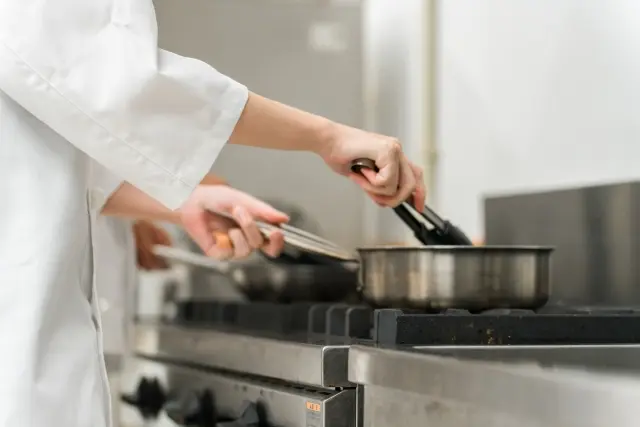
Site Characteristics:
A company cafeteria that provides meals for many employees. Balancing hygiene management and environmental measures is required.
*The image is for illustrative purposes only.
■ The Decisive Factor: Flexibility to Choose Between “Liquid Fertilizer Use" and “Sewer Drainage"
The reason they chose GOMISER (annihilation type) instead of a composting type was the flexibility in handling the generated product. GOMISER decomposes and liquefies food waste, and the generated liquid can be “collected as 'liquid fertilizer’ only when and as much as needed." If there are times when liquid fertilizer is not used or there is a surplus, it can be “discharged directly into the sewer." The decisive factor was that it could effortlessly balance recycling and zero emissions without the risk of “trouble disposing of the finished compost," which is common with composting types.
A New Form of Resource Circulation
The aqueous solution processed by GOMISER is rich in nutrients such as amino acids. By utilizing this as fertilizer for planting, it can also contribute to greening activities within the factory. It is a processing method suitable for the SDGs era, turning “disposal" into “utilization."
▶ Click here for details on “GOMISER," which also allows for the use of liquid fertilizer
■ Effects After Installation: No Dedicated Staff Required. Easy Operation Anyone Can Handle
It has received high praise regarding operation after installation. Because the operation is extremely simple—"just input the food waste"—there is no need to assign dedicated staff, and anyone in the kitchen staff can handle it easily. It has become possible to process food waste without spending on labor or effort, and running costs are kept low. As a result, they were able to achieve the major goal of “zero food waste discharge" without increasing their burden.
- ✅ Easy Operation: No dedicated staff is needed because you just put it in.
- ✅ Low Cost: Low running costs enable continuous operation.
- ✅ Zero Emissions: Cafeteria food waste is completely processed and turned into resources on the premises.
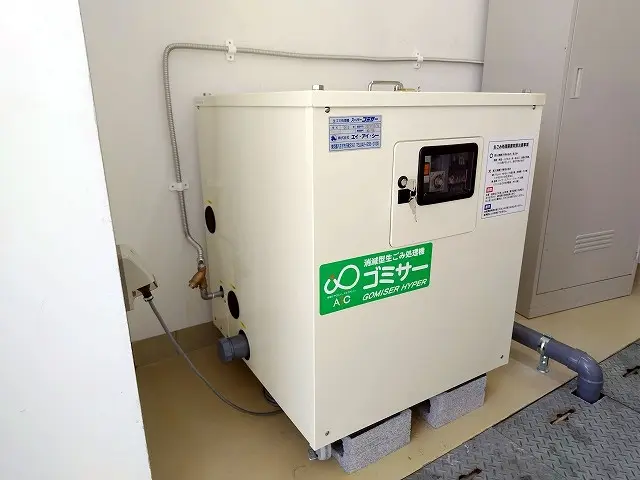
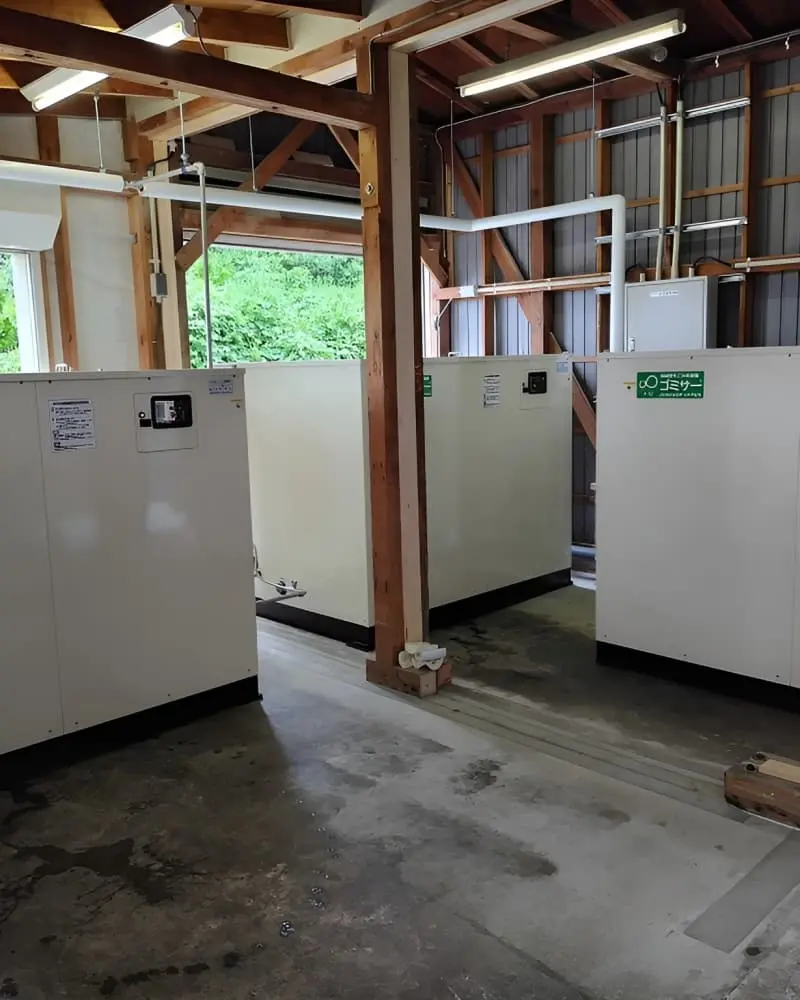
(Photo: The GH-10 model with a compact design that can be installed inside the kitchen)
■ AIC Comments
When choosing a commercial food waste disposer, we recommend considering the following points.
- Processing Capacity: Choose according to the amount of food waste you want to process per day.
- Installation Space: Check the size of the installation location and necessary facilities.
- Processing Method: There are drying, composting, and annihilation types, each with different characteristics.
- Running Cost: Consider electricity bills, consumables (bacteria beds, deodorizing filters, etc.), and maintenance costs.
- Maintenance: Also check the frequency of daily cleaning and parts replacement, and maintenance services by specialists.
This installation case study at a manufacturing factory is exactly the result of comprehensively judging these points. By adopting the “Annihilation Type (Processing Method)" that fits into the limited “Installation Space" within the kitchen and requires no compost management, it became possible to efficiently process even small amounts of food waste. Furthermore, the operability that anyone can handle during daily work and the low “Running Cost" make the entire factory’s zero-emission activities sustainable.
Customer Voices & Q&A
Commercial Food Waste Disposer “GOMISER®" GH-10
An annihilation-type food waste disposer featuring a compact design that fits neatly inside a commercial kitchen. The decomposed liquid can be flexibly recycled as “liquid fertilizer" or simply discharged into the “sewer," contributing to zero-emission activities without management hassle even at sites generating small volumes of waste.
Free Consultation for Corporate & Cafeteria Managers
Professional Support to Promote SDGs
& Drastically Reduce Total Costs
Our experienced specialist staff will answer your questions for free, such as “How much cheaper will it be compared to our current waste collection fees?" or “What size is suitable for our cafeteria’s capacity?"
We also offer advice on “indoor kitchen installation feasibility" and online site hearings.
Simulate the Installation Effects for Your Company for Free
Find out your "cost reduction" and "CO2 reduction" instantly based on your current data.