

[Case Study] Seafood Factory: Food Waste Disposer GOMISER | AIC
CASE STUDY: FOOD PROCESSING FACTORY (AOMORI PREFECTURE)
Completely Decomposing “High-Oil Fish Waste" That Other Companies Gave Up On.
Installing 3 Large Units for Drastic Cost Reduction, Expecting Amortization in 3 Years
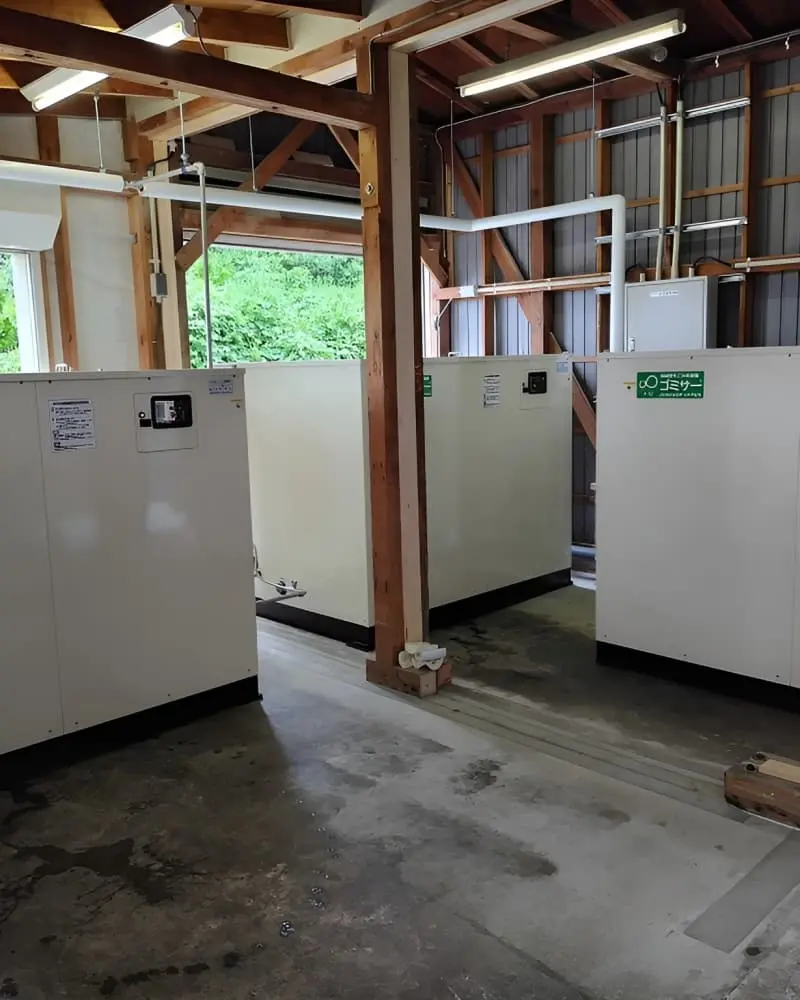
Installed Model: Commercial Food Waste Disposer GOMISER GH-100 x 3 units
Decomposition power for “High Oil and High Protein" proven in demonstration experiments.
■ Challenges Before Installation: Continuously Ballooning Industrial Waste Costs and Processing Difficulties
For Company H, a seafood processor in Aomori Prefecture, reducing the disposal costs of the massive amounts of “fish scraps" and “residue" discharged from their factory was a major issue.
They considered installing a food waste disposer to reduce the frequency of collection and transportation and cut costs, but the nature of the waste handled (high oil, salt, and moisture content) became a hurdle, making model selection difficult.
- Processing Capacity: “Fish meat" rich in oil and protein is difficult to decompose, resulting in failures with other companies’ machines.
- Cost Reduction: A desire to reduce the costs associated with frequent collection and transportation to increase profitability.
- Environmental Consideration: As a local company, they were expected not just to dispose of waste, but to contribute to the SDGs.
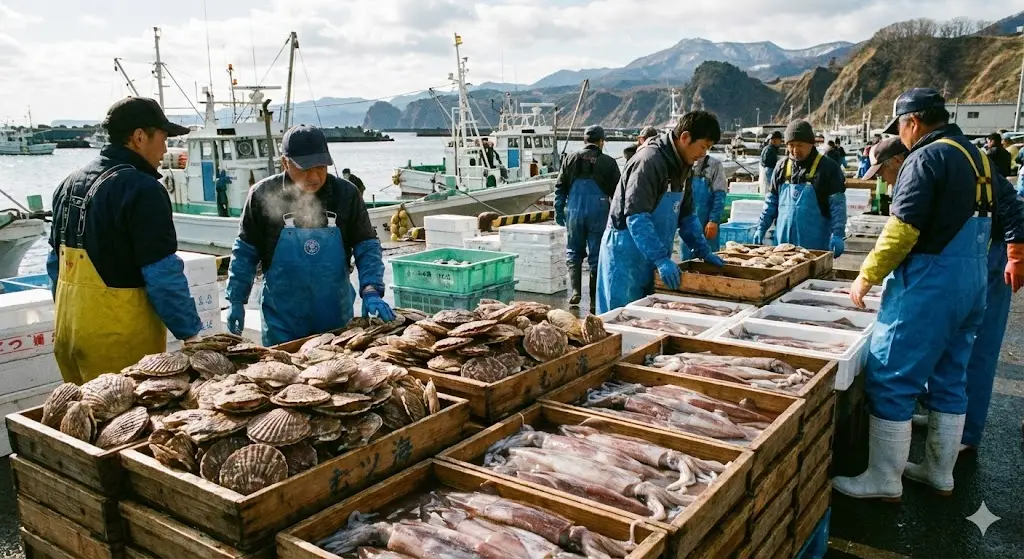
Site Characteristics:
“High-oil fish waste," unique to seafood processing, was a formidable enemy that general disposers could not fully decompose.
■ The Decisive Factor: The Only Proven Track Record of Processing “Fish Waste" That Others Failed At
The biggest deciding factor was the “demonstration results with a demo unit." In fact, they had previously conducted tests with annihilation-type disposers from other companies, but abandoned the installation because those machines could not decompose the oily fish waste. However, when the same test was conducted with AIC’s GOMISER, it decomposed and annihilated the waste smoothly without any problems. The conviction of “This will work," along with running costs lower than those of competitors, was the clincher for the installation.
For a Fail-Proof Selection
“Oil content," “salt content," and “massive processing volumes" in food factories are the harshest conditions for a food waste disposer. We have published the criteria for selecting a model suitable for the site, which cannot be determined from catalog specs alone.
▶ How to Choose a Commercial Food Waste Disposer | 6 Points for Success
■ Effects After Installation: Aiming for ROI in 3 Years with the Operation of 3 Large Units
Although it was a large-scale investment to install three large “GH-100" units, factory residue almost disappeared after installation, drastically reducing collection, transportation, and outsourcing processing costs.
Estimates indicate that “depreciation (ROI) is possible in about 3 years," realizing a “proactive cost reduction" where the reduced amount translates directly into profit from the fourth year onwards.
- ✅ Dramatic Volume Reduction: Fish scraps disappear, eliminating the need for waste storage space.
- ✅ Cost Reduction: Transportation and incineration costs decreased drastically. A highly profitable model expecting ROI in 3 years.
- ✅ Maintenance: Requires less frequent maintenance compared to competitor products, alleviating the on-site burden.
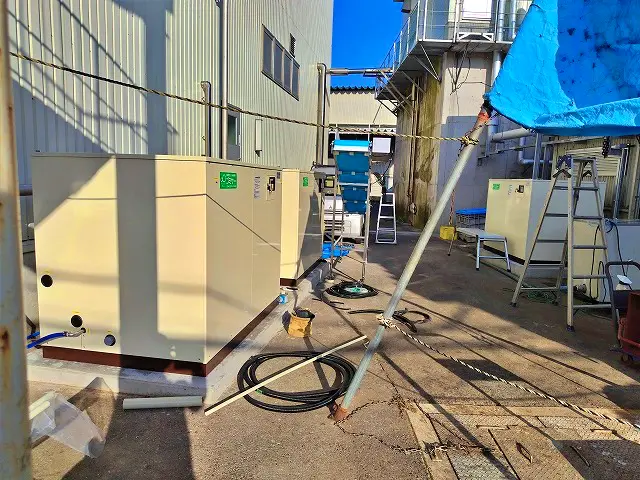
(Photo: Three GH-100 units installed outdoors, processing massive amounts of residue daily)
■ AIC Comments: Enhancing Corporate “Brand Power"
Amid growing awareness of environmental issues, companies that install food waste disposers and strive to reduce waste have the potential to gain higher evaluations from local communities and consumers. It also leads to improving corporate brand image.
In addition, overcoming the processing of “high-concentration oil" in food processing, as in this case study, dramatically improves the hygienic environment within the factory and is extremely effective as an HACCP measure. It is an investment that enhances corporate value from multiple angles, going far beyond mere cost reduction.
Q&A Regarding Food Factories and Large-Scale Installations
Commercial Food Waste Disposer “GOMISER®" GH-100
A large-scale processing machine that powerfully decomposes and annihilates “oily fish meat and scraps" and “high-protein residue," which are considered difficult for competitor machines to decompose. It is ideal for food factories struggling with massive amounts of unprocessable residue. Its overwhelming processing capacity and low running costs enable ROI (substantial reduction in industrial waste costs) in just a few years.
Free Consultation for Food Factories & Manufacturers
Professional Support to Improve Factory Environments
& Drastically Reduce Total Costs
Our experienced specialist staff will answer your questions for free, such as “How much cheaper will it be compared to our current waste collection fees?" or “Can it process our highly oily residue?"
We also offer processing tests using actual residue and online site hearings.
Simulate the Installation Effects for Your Company for Free
Find out your "cost reduction" and "CO2 reduction" instantly based on your current data.