

[Case Study] JSDF Base Achieves Zero Emissions via GOMISER | AIC
CASE STUDY: GOVERNMENT & DEFENSE FACILITIES (JSDF)
Solving the Residue Issue of “Composting-Type" Disposers.
Adopting an “Extinction-Type" System That Decomposes Waste into Water and CO2
to Achieve True Zero Emissions Without Bio-Media Disposal
Installed Model: Commercial Food Waste Disposer GOMISER® GH-35
Conventional “composting-type (drying-type)" disposers only reduce waste volume, leaving behind residue (compost) that must ultimately be discarded as waste.
By adopting the “extinction-type" GOMISER®, which decomposes food waste into water and carbon dioxide without requiring periodic full replacement or disposal of the bio-media, the facility achieved true zero food waste discharge and high-level environmental impact reduction.
■ Background of Inquiry: “Composting-Type" Disposers Leave Residue and Cannot Achieve True Zero Emissions
As part of its ongoing environmental conservation initiatives, this Japan Self-Defense Forces (JSDF) facility had been actively working to reduce food waste generated on-site and was evaluating the installation of a commercial food waste disposer.
However, conventional “composting-type (drying-type or standard bio-type)" food waste disposers merely evaporate moisture to reduce volume, inevitably leaving behind solid residue (composted waste). With a system where this byproduct must ultimately be discarded as garbage, the facility faced a clear operational challenge: it could not achieve its organizational goal of “complete zero food waste discharge (Zero Emissions)."
■ The Decisive Factor: A Complete “Extinction-Type" System with Zero Residue and Zero Bio-Media Disposal
To achieve true zero emissions, the facility selected the GOMISER® (GH-35 model) as a residue-free “extinction-type" food waste disposer. Utilizing powerful microbial activity, GOMISER® decomposes and extinguishes food waste into water (decomposed liquid) and carbon dioxide, eliminating the labor-intensive task of removing and discarding residue associated with composting models.
Furthermore, it does not require the periodic “full replacement of the bio-media (bacterial bed)" commonly needed in competitor biological machines. This ultra-low environmental impact design—where “not only is there zero food waste residue, but there is also no need to discard used bio-media as waste"—perfectly aligned with their SDG objectives and served as the deciding factor for adoption.
■ Installation Site & Results: Outdoor Setup Meeting Strict Safety Standards and Achieving Zero Emissions
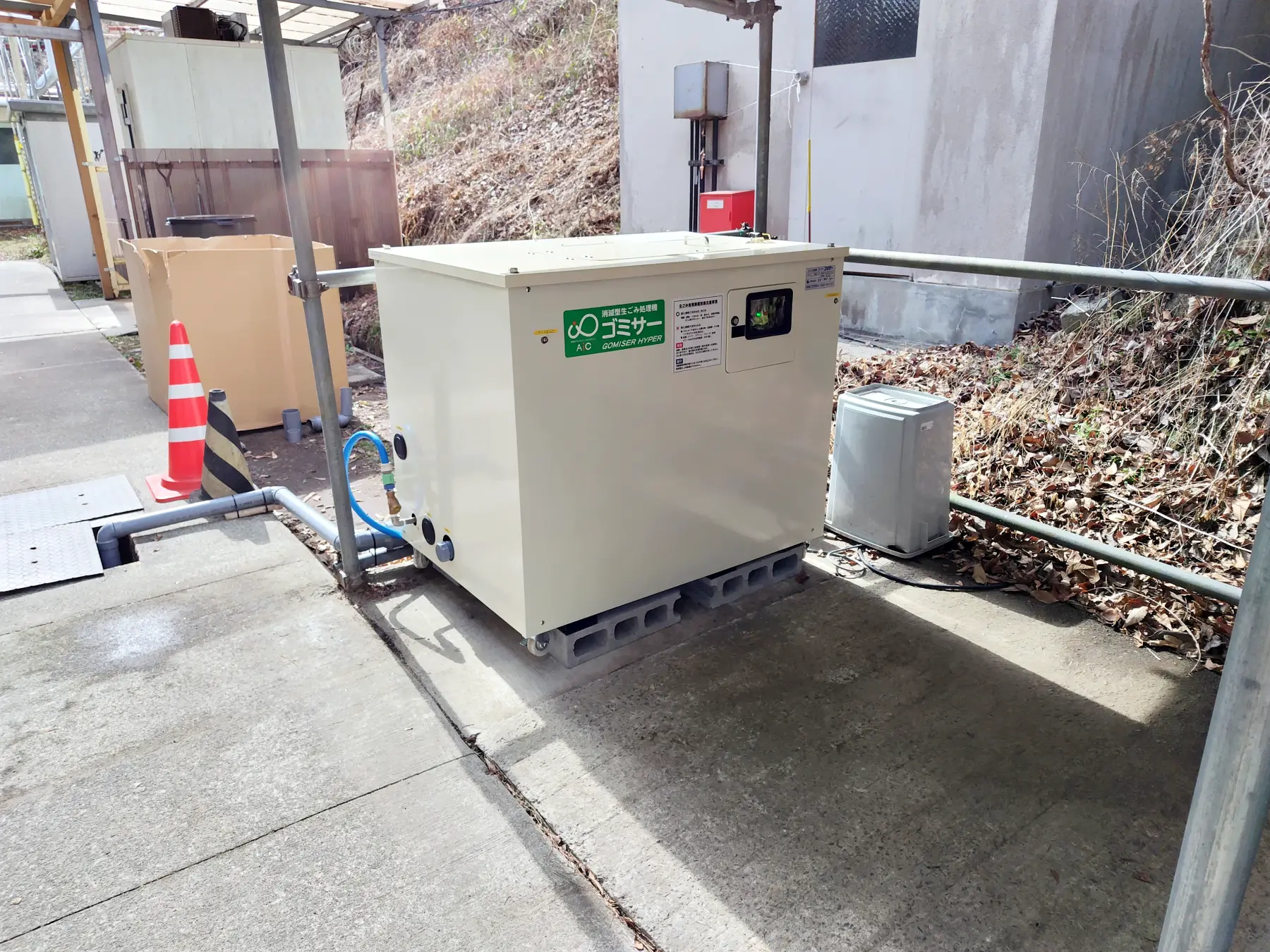
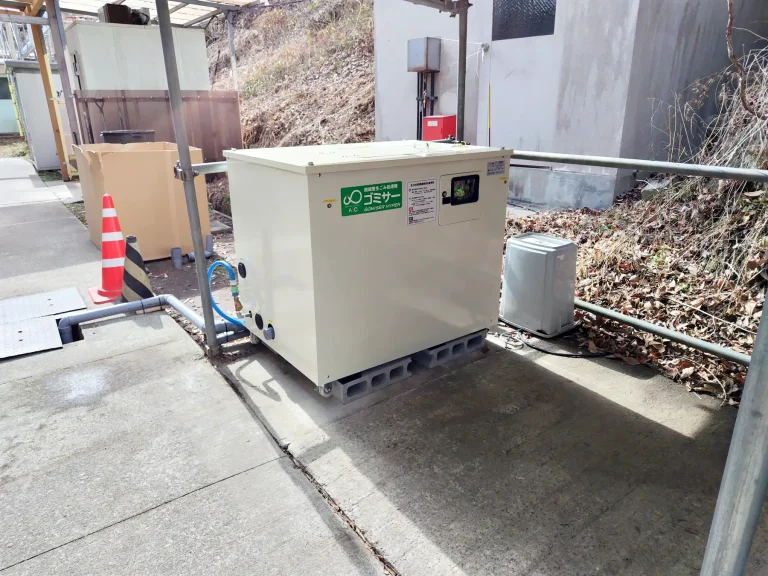
(Photo: The GH-35 model installed in an outdoor space within the facility)
The GH-35 model was installed in an outdoor space on the premises. Featuring a stable concrete-block foundation and perimeter safety markings with cones and warning tape, a clean and secure operating environment was established in strict compliance with the rigorous safety standards required of government and defense facilities.
Since commissioning, all input food waste has been rapidly liquefied and extinguished, bringing the facility’s external food waste discharge down to “zero" exactly as planned.
By successfully shifting from “reducing waste volume" to “eliminating waste generation altogether," the facility has simultaneously reduced the daily workload for personnel and achieved high-level environmental impact reduction (SDGs and Zero Emissions).
■ AIC Comments: Expert Perspective
When corporations, municipalities, and government agencies set “Zero Emissions" goals in their environmental initiatives, choosing the wrong type of equipment—such as a composting-type disposer—often prevents them from reaching their target. This case study represents an ideal model where the organizational objective and the processing technology are perfectly aligned.
[Professional Know-How] Why the “Extinction-Type" is Essential for True Zero Emissions
- ✓ The Crucial Difference Between “Volume Reduction" and “Extinction": Conventional drying-type disposers merely evaporate moisture to shrink waste volume, leaving behind dried organic residue (compost base). Unless a facility owns farmland capable of consuming 100% of this output, the remaining residue must still be discarded as industrial waste. To truly reduce food waste discharge to zero, selecting an “extinction-type (bio-liquefaction technology)" system that converts organic matter into water and carbon dioxide is an absolute prerequisite.
- ✓ Eliminating the Hidden Blind Spot of “Bio-Media Disposal": Even among competitor biological disposers, many models require users to periodically extract all degraded bio-media (woodchips or carriers) and discard it as waste. Because GOMISER® requires no full bio-media replacement, it prevents secondary waste generated by the machine itself, enabling organizations to meet strict environmental and SDG targets.
Frequently Asked Questions (FAQ) from Facilities Aiming for Zero Emissions
* Note on Global Support:
The installation procedures and direct on-site support described in this case study reflect our standard operations within Japan. As we are currently in the initial phase of our global expansion and actively developing a network of local partners, our international service is presently focused on equipment supply and remote consultations. On-site foundation work, plumbing and electrical connections, and local maintenance must be arranged by the customer in strict compliance with local regulations until authorized local partners are established in your region.
Commercial Food Waste Disposer “GOMISER®" GH-35
A standard model capable of processing up to 35kg of food waste per day. Unlike “composting-type" disposers that leave behind solid residue, GOMISER® is a true “extinction-type" system that liquefies and extinguishes organic waste. Requiring no full bio-media replacement or disposal, it is ideal for corporations, public institutions, and defense facilities pursuing SDGs and Zero Emissions.
Free Consultation for Public Institutions, Corporate & Facility Managers
Achieve True Zero Emissions & Cost Reduction
with “GOMISER®"
We propose the optimal model and installation plan tailored to your daily food waste volume and facility requirements.
We also welcome inquiries regarding “Remote Consultations," “Technical Specifications," and “Local Partner Opportunities."
Installation Examples of Gomiser & Gomisupporter
Simulate the Installation Effects for Your Company for Free
Find out your "cost reduction" and "CO2 reduction" instantly based on your current data.