

[Case Study] Cafeteria SDGs: Food Waste Disposer GOMISER | AIC
CASE STUDY: CORPORATE & COMPANY CAFETERIAS (PROMOTING SDGs)
Aiming for “Zero Food Waste Discharge" Through SDGs.
Choosing the “Annihilation Type" to Solve the Challenges (Management & Residue) of Composting Types
Installed Model: Commercial Food Waste Disposer GOMISER GH-20
Achieved both food waste reduction and cost lowering, which are SDG goals, being almost maintenance-free.
■ Challenges Before Installation: The “Management Effort" That Composting Types Cannot Fully Solve
A certain company promoting initiatives toward the SDGs (Sustainable Development Goals). As part of this, they were considering installing a disposer with the aim of “reducing and eliminating food waste generated from the company cafeteria." Initially, they considered a “composting type" disposer to use the generated product for in-house vegetable gardens and tree planting. However, as they proceeded with their research, operational hurdles unique to composting types surfaced, such as the “difficulty of moisture adjustment" and “restrictions on input materials (many things are not allowed)." Furthermore, there was a concern that “if residue (compost) is produced, we might not be able to use it all and end up throwing it away as garbage anyway," leading them to seek an alternative method.
- Operational Difficulty: Managing moisture levels and sorting input materials is strict, placing a heavy burden on the site.
- Residue Problem: Even if compost is made, if there is no use for it, they would ultimately have to dispose of it as “garbage."
- Fundamental Reduction: From the perspective of SDGs, they wanted to aim not just for recycling but for “eliminating the discharge itself."
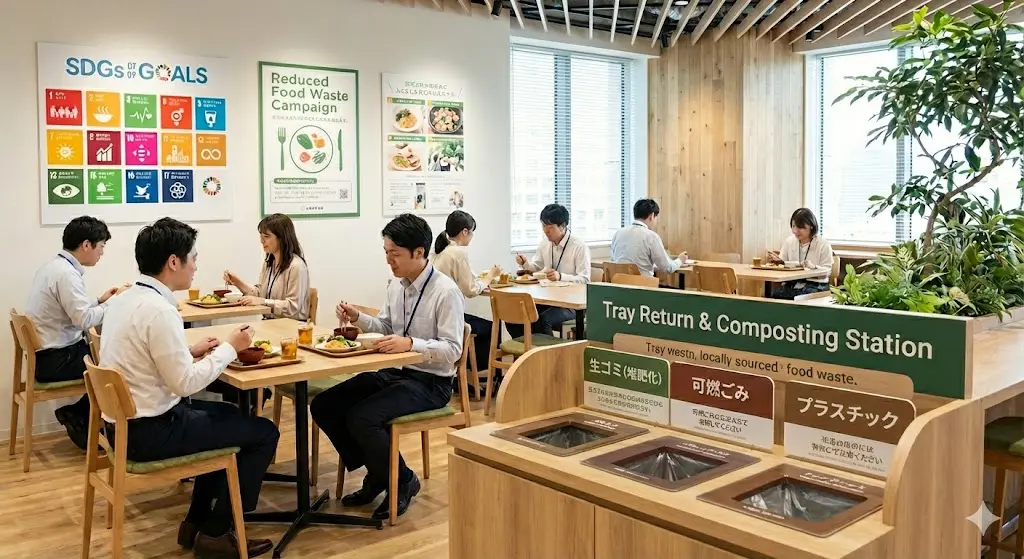
Site Characteristics:
The “cafeteria food waste problem" faced by many companies. What is required is not only recycling but also a sustainable operation that does not put a load on the site.
*The image is for illustrative purposes only.
■ The Decisive Factor: “No Odor" and “Ease of Use" Confirmed Through a Facility Tour
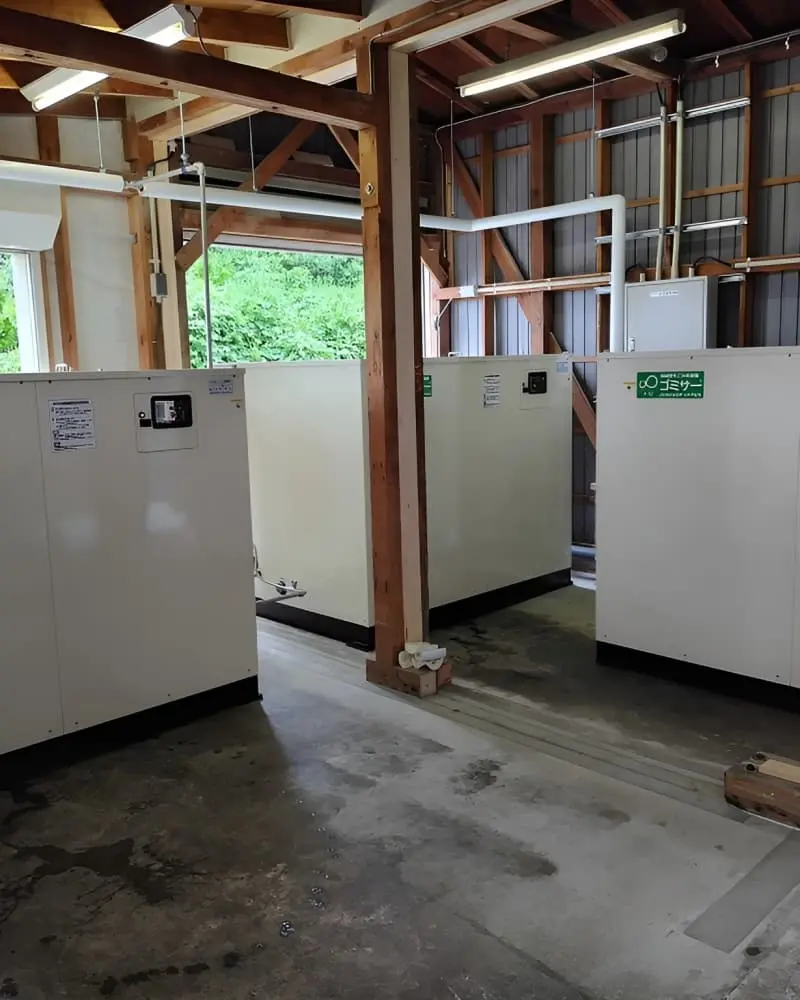
The person in charge, who previously did not know about “annihilation type" disposers, experienced a turning point when they toured a nearby facility that actually uses GOMISER. They confirmed with their own eyes and nose at the operating site that “it is extremely easy to handle" and, above all, “there is absolutely no odor," prompting an immediate decision to install it. Furthermore, because the decomposed liquid from GOMISER can be used as “liquid fertilizer" if necessary, it was evaluated for its flexibility in supporting their initial goal of recycling activities (such as watering plants).
Seeing is Believing: Recommendations for Tours
The “operating noise" and “odor," which cannot be understood from catalog specs alone, are best confirmed by touring an actual unit. At AIC, we guide you to tours of installation sites close to your industry.
▶ Click here for consultations on facility tours and installation
■ Effects After Installation: Food Waste Truly Disappears. Maintenance Costs Are Low, and “It’s a Great Help"
As their impressions after actually starting operations, we received joyful feedback saying, “Food waste truly disappears, there is no odor, and it can be processed without hassle, so it’s a great help." The daily task is just to put the waste in. “Maintenance" only requires replenishing the bacterial core (nutritional source for microorganisms) a few times a year and simple water washing cleaning about once a month. The fact that running costs (maintenance expenses) are kept extremely low without requiring expensive maintenance fees is also a major advantage in continuous SDG activities.
- ✅ Hassle-Free Operation: Difficult moisture adjustment and residue removal work are unnecessary.
- ✅ Low-Cost Maintenance: Almost no maintenance costs are required, compressing running costs.
- ✅ Improved Hygienic Environment: Because there is no odor, it does not compromise the comfort of the kitchen or cafeteria.
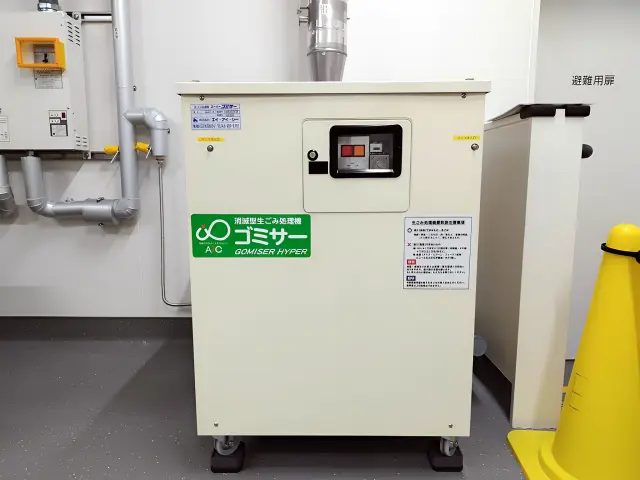
For a company cafeteria using the GH-20 model, 150 to 180 meals is the guideline for model selection.
■ AIC Comments
Installing a commercial food waste disposer can clearly demonstrate a company’s commitment to reducing environmental impact. Contributing to the SDGs, in particular, enhances reputation among customers and business partners. The stance of tackling food waste reduction and recycling through a food waste disposer becomes a selling point as an environmentally conscious company.
You can also promote the fact that you are suppressing bad odors and pests caused by storing food waste, realizing a hygienic and comfortable work environment. This also leads to improved employee satisfaction and contributes to forming an image of a rewarding company to work for.
The ability to reduce the cost and effort of food waste disposal is also an element that appeals to the efficient management of a company. By concretely showing the cost reduction effects from a long-term perspective, you can convey a solid management stance to customers.
As in this case study, consultations like “We want to install it for SDGs, but we don’t want to increase the burden on the site (such as compost management)" are increasing. GOMISER (annihilation type) is the only solution that can simultaneously achieve the result of “eliminating food waste" and the process of “not requiring effort." It has become a wonderful case study that simultaneously achieved not only an improvement in corporate image but also substantial cost reduction and operational efficiency.
Customer Voices & Q&A
Commercial Food Waste Disposer “GOMISER®" GH-20
An annihilation-type food waste disposer that completely decomposes waste into water and carbon dioxide without leaving any residue. It eliminates the management hassles of composting types, such as “removing residue" or “securing a use for compost," achieving both “zero food waste discharge (SDGs)" and “industrial waste cost reduction" without increasing the burden on on-site staff.
Free Consultation for Corporate & Cafeteria Managers
Professional Support to Promote SDGs
& Drastically Reduce Total Costs
Our experienced specialist staff will answer your questions for free, such as “How much cheaper will it be compared to our current waste collection fees?" or “What size is suitable for our cafeteria’s capacity?"
We also offer advice on “indoor/outdoor installation feasibility" and online site hearings.
Simulate the Installation Effects for Your Company for Free
Find out your "cost reduction" and "CO2 reduction" instantly based on your current data.