

[Case Study] Factory Saves $7,500/mo on Waste via GOMI SUPPORTER | AIC
CASE STUDY: FOOD FACTORY (HIGH-VOLUME PROCESSING & COST REDUCTION)
Reducing Industrial Waste Costs by Approx. $7,500/Month and Heavy Labor.
Completely Processing 99% Moisture Konjac Residue with the “Annihilation Type"
Installed Model: Large Commercial Food Waste Disposer GOMI SUPPORTER GSP-350
■ Challenges Before Installation: Enormous Disposal Costs Due to 99% Moisture and Bad Odor Damage to the Neighborhood
In the konjac manufacturing process, because 99% of the product is water, disposal is calculated by “weight," resulting in an enormous industrial waste disposal cost of nearly $7,500 (1 million JPY) per month. Furthermore, the bad odor during summer while stored in containers was a serious problem that could cause annoyance to neighboring residents. The burden on the on-site staff was also significant; they had to transport heavy residue baskets weighing about 50 to 60 kg, full of moisture, to the outdoor containers using a forklift, taking up a great deal of effort and time.
⚠️ Issues Considered at the Time
- Enormous Industrial Waste Costs: Disposal costs soared due to the weight calculation of high-moisture residue.
- Heavy Labor & Inefficiency: The effort of transporting 50-60kg baskets with a forklift.
- Bad Odor Risk: Odor problems affecting the neighborhood due to summer container storage.
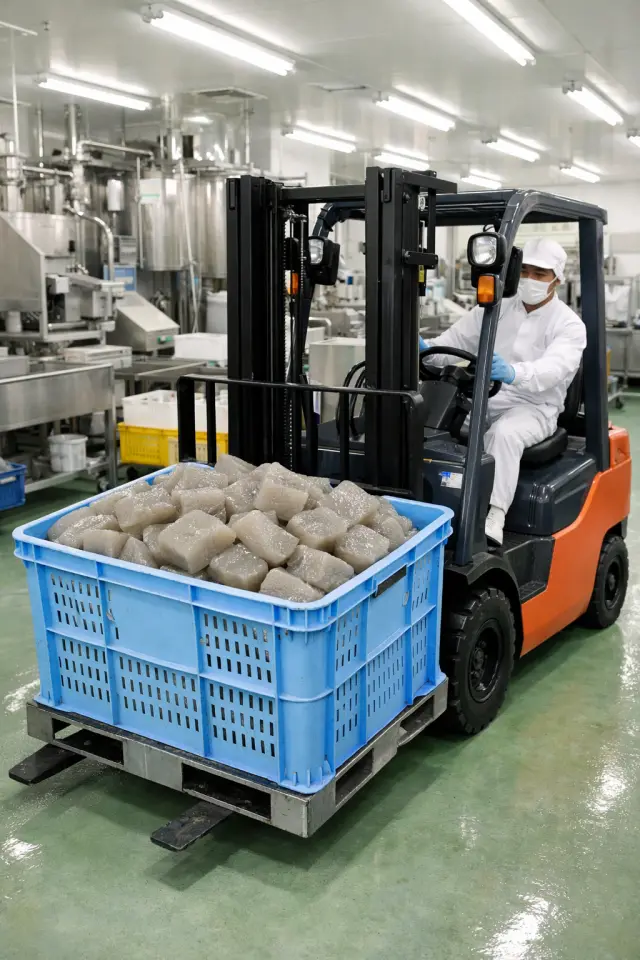
Site Characteristics:
Heavy konjac residue packed with moisture. Previously, the heavy labor of transporting 50-60kg baskets outdoors with a forklift occurred.
*The image is for illustrative purposes only.
■ The Decisive Factor: The Overwhelming Track Record of the “Annihilation Type," Optimal for High-Moisture Residue
While considering food waste disposers, they were aware of composting and drying types, but judged that “drying types are unsuitable" for konjac, which has extremely high moisture content. In the midst of this, they learned about the “annihilation type" GOMI SUPPORTER, which decomposes waste into water and carbon dioxide using the power of bacteria. The decisive factors for installation were its abundant track record in konjac factories and the fact that they could confirm with their own eyes how it reliably processed the waste using an actual demo unit.
■ Effects After Installation: The Task of Disposing Outside Disappears. Directly Linked to Hygiene Management (HACCP)
Upon installation, a “sink with a crusher" was set up inside the factory, creating a system where the on-site staff simply throw the food waste into it. Because the food waste is automatically transported to the disposer by this, the hassle of transporting and processing heavy baskets like before was dramatically reduced. Not only did they succeed in their primary goal of significantly reducing disposal costs, but by eliminating the actual movement of “going out of the factory just to throw away garbage," the risk of bacteria and insects invading from the outside decreased, directly leading to an improvement in the level of hygiene management inside the factory. We also received very happy feedback from the customer saying, “We are satisfied with the installation."
- ✅ Plummeting Industrial Waste Costs: Succeeded in reducing enormous disposal costs caused by the weight of the moisture.
- ✅ Zero Transportation Work: Automatic transportation just by putting it into the indoor sink. Freed from heavy labor.
- ✅ Improved Hygienic Environment: Hygienic because there is no going in and out of the factory to take out the garbage.
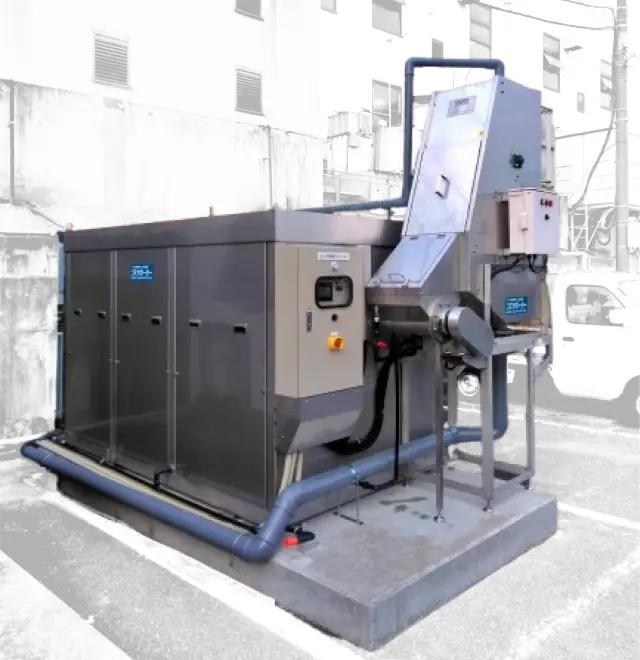
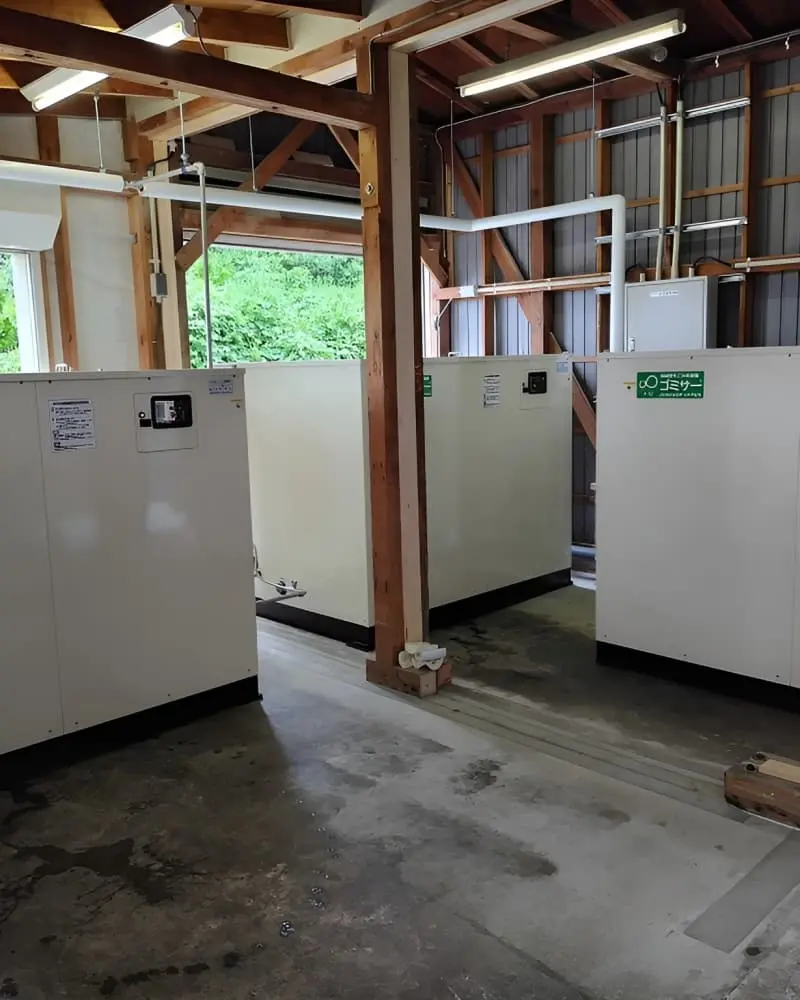
[Installed Model: GOMI SUPPORTER GSP-350]
Linked with a crushing system, it stably decomposes and annihilates massive amounts of high-moisture konjac residue.
[Diagram] Mechanism of the Automatic Food Waste Transportation & Processing System
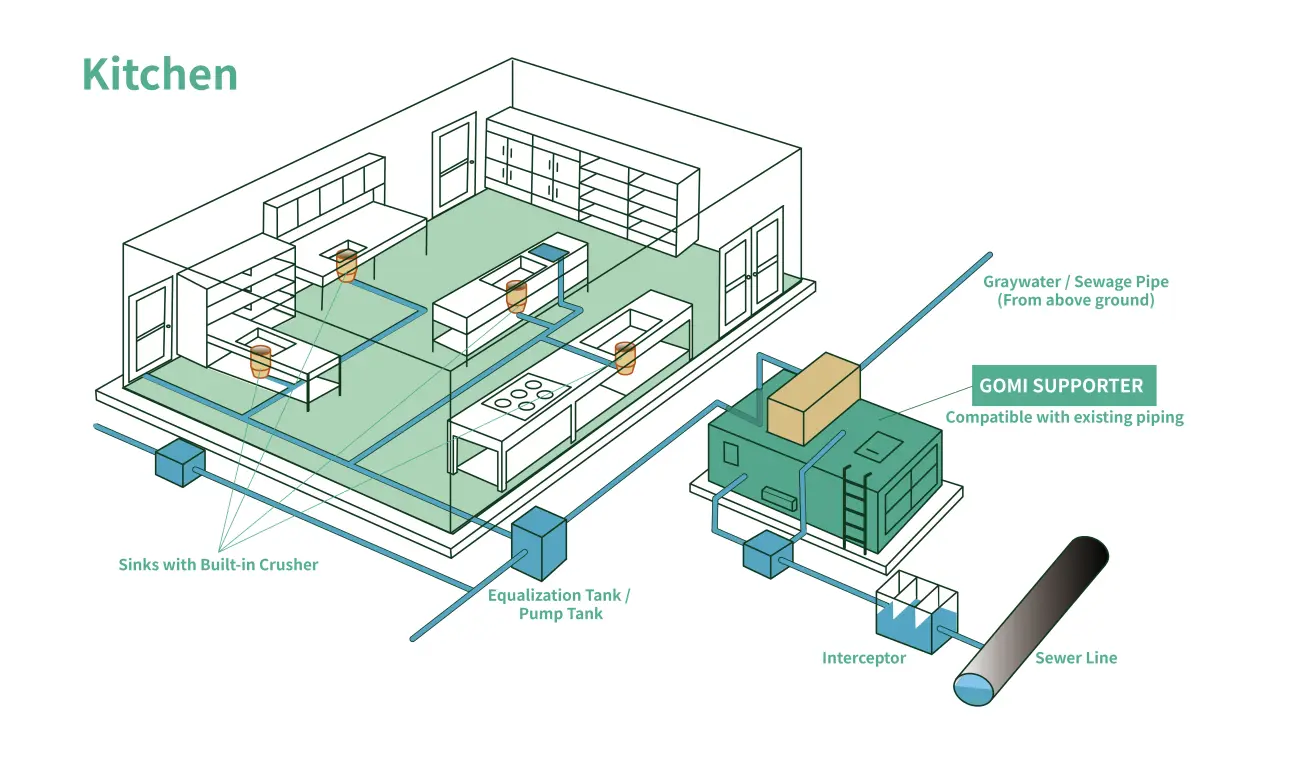
Key Point:
By simply putting food waste (konjac residue) into the sinks inside the factory, it is automatically sent through pipes to the outdoor disposer (GOMI SUPPORTER). This is an innovative system that completely eliminates the physical movement of carrying heavy baskets, dramatically improving the hygienic environment within the factory.
[Demonstration Video] The Overwhelming Processing Power of GOMI SUPPORTER

*This video is a common demonstration video for both GOMISER and GOMI SUPPORTER. You can verify how food waste is decomposed and annihilated.
■ AIC Comments
Installing a commercial food waste disposer provides the following benefits:
- Reduction of Disposal Costs: Because the volume of food waste discharged from business sites is extremely large, its processing incurs massive costs. Installing a food waste disposer can reduce these costs. In the long run, even including initial costs, it is expected to lead to cost reduction.
- Improvement of the Hygienic Environment: Because the time food waste is stored at the business site decreases, the risk of bacteria and virus outbreaks can be suppressed, improving the hygienic conditions of the workplace and surrounding areas.
- Reduction of Environmental Impact: While incinerating food waste leads to an increase in CO2 emissions, a disposer can significantly reduce those emissions. Processing food waste on-site also reduces CO2 emissions during transportation.
In particular, when “food residue with an extremely high moisture content (99%)," such as konjac, is incinerated or put into a drying-type disposer, an enormous amount of thermal energy (fuel/electricity) is wasted to evaporate the water. The “annihilation type" GOMISER/GOMI SUPPORTER, which utilizes the moisture of the food waste as it is for self-contained processing, is truly the most logical ecosystem for cost reduction and decarbonization (promotion of SDGs) in food factories.
Furthermore, the “system that does not take garbage outside the facility" realized through linkage with the “crushing and pumping system" in this case study blocks the risk of cross-contamination and greatly contributes to building an advanced hygiene management system compliant with HACCP.
Customer Voices & Q&A
Large Commercial Food Waste Disposer “GOMI SUPPORTER" GSP-350
A large-scale centralized processing system that speedily annihilates massive amounts of food residue generated within factories. By linking it with a sink-integrated crushing system, it completely eliminates the heavy labor of transporting garbage outdoors, simultaneously achieving HACCP compliance (advanced hygiene management) inside the factory and massive reductions in industrial waste costs.
Free Consultation for Food Factories & Manufacturing Industries
Professional Support to Improve Factory Hygiene
& Drastically Reduce Total Costs
Our experienced specialist staff will answer your questions for free, such as “How much cheaper will it be compared to our current waste collection fees?" or “Can it process the residue (moisture content, etc.) from our factory?"
We also offer processing tests using actual residue and online site hearings.
Simulate the Installation Effects for Your Company for Free
Find out your "cost reduction" and "CO2 reduction" instantly based on your current data.